
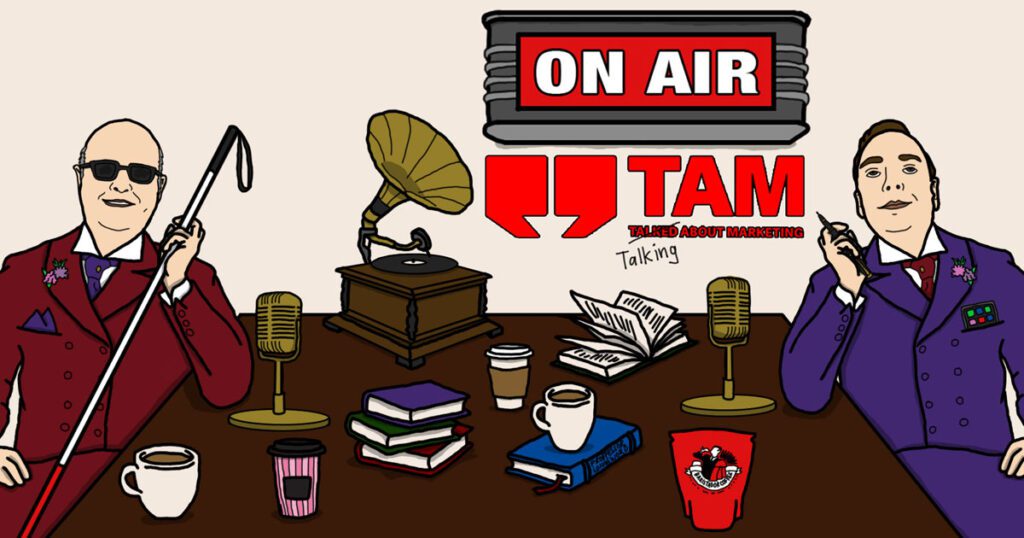
From Ed Koper’s anatomy of online rage to Clive Palmer’s tone-deaf TV ads, this episode maps the eight ways social media tries to hijack your brain, and hands small business owners a calm, clear path through.
Ed Koper’s book Angertainment gives Steve and David a precise vocabulary for what most of us feel but struggle to name: the social media machine is not broken, it is working exactly as designed, and that design is not working for you.
David draws the line that every small business owner needs to hear: your customers are not the mob, and the mob does not care about your business.
A couch cleaning search goes sideways when Steve finds a local tradesperson’s website where the Adelaide suburbs have migrated to Darwin, Alice Springs, and Melbourne, and the copy reads like it never met a human being.
Clive Palmer’s 2014 political ads get the Perspicacity treatment, and the verdict is the same lesson in a different costume: if your message starts with what matters to you, not what matters to them, it lands nowhere.
Get ready to take notes.
Talking About Marketing podcast episode notes with timecodes
02:00 Person This segment focusses on you, the person, because we believe business is personal.
Ed Koper’s Field Guide to the Eight Types of Online Rage (and Why Your Temperature Rising Is Not an Accident)
Steve opens the final episode of Season 8 with Angertainment, Ed Koper’s forensic examination of how social media platforms and their most active users have turned anger into a business model. The book’s central argument is not that social media is unpleasant but that its unpleasantness is deliberate, repeatable, and categorised. Koper names eight distinct post types designed to generate heat rather than light, and Steve and David walk through each one with the kind of wry recognition that comes from having seen all of them in the wild.
The eight types cover a lot of ground:
- Righteous anger activation (moral language designed to recruit, not inform)
- Tribal identity framing (are you with us or against us?)
- False consistency shaming (collapsing complexity into a gotcha)
- Decontextualised rage bait (the 10-second clip stripped of the 30 seconds that would change everything)
- Cancel mob mechanics (collective punishment at scale)
- Merchants of outrage (coordinated discontent dressed as grassroots)
- Propagandatainers (whose primary business model is keeping you angry)
- Distraction (look over here while the real story disappears)
One example from the book: a single can sent to a single influencer, and a social media structure that turned a minor marketing decision into congressional investigations and millions in lost sales.
Steve frames the eight types through the lens of The Emperor’s New Clothes: once you can name what you are looking at, it loses its power over you. David adds the Jonathan Haidt layer, noting that the moral combat these posts trigger makes reasonable conversation almost impossible, and that recognising the tactic early is the first step toward choosing not to play. If your temperature is rising, Steve says, it is probably not an accident.
15:15 Principles This segment focusses principles you can apply in your business today.
What the Rage Has to Do With Your Next Facebook Post (More Than You’d Like)
The Principles segment moves the Angertainment conversation from survival to strategy: if this is the environment, how does a small business owner post anything at all without being swept into the current or mistaken for part of it? David’s position is direct. You are talking to a hero who needs a guide to solve a problem. That is your job on social media. The moment you wander outside that lane and into tribal commentary, you stop being a guide and become just another voice in the emotional weather.
His practical guidance covers the basics:
- Share photos of great work
- Tell the stories of people who love what you do
- Describe the new thing you have worked out you can help people with
Accept that these posts will not go viral. Accept that the likes will be modest. And then ask yourself the only question that actually matters for a business: are the people who do engage calling you, enthusiastically, ready to talk about how you can help them?
Steve adds the cautionary note from personal experience. He has a standing rule about not engaging in political discussion on social media because the medium strips out every nuance that makes such conversations worthwhile. When pitchforks arrive at your gate by accident, David’s prescription is equally clear: before you respond, ask whether the mob is interested in listening or just needs its next dopamine hit. If it is the latter, the most effective thing you can do is nothing. Do not post for two days. Let the outrage find its next target. The memory, David notes, is very short.
21:30 Problems This segment answers questions we've received from clients or listeners.
When the Map of Adelaide Puts Norwood Where Alice Springs Should Be
Steve’s couch needed cleaning after an 18th birthday party. What followed was a cautionary tour of local tradesperson websites that had apparently been generated entirely by AI, reviewed by nobody, and published without a moment’s hesitation. The copy was repetitive, the language was hollow, and the service area map had transposed every Adelaide suburb to a random location across the Australian continent. Norwood sat where Alice Springs should be. Brighton appeared somewhere near Sydney. Port Adelaide had migrated to Melbourne.
David’s heuristic for evaluating any website comes down to two questions. Was the person who made this website proud of it? Is the company that had it made proud of it? If you cannot say yes to both, move on. For small business owners, the message runs the other way: if you would be embarrassed to have someone scrutinise your site the way Steve scrutinised that cleaning company’s, that is worth acting on before your next potential customer does it for you.
24:45 Perspicacity This segment is designed to sharpen our thinking by reflecting on a case study from the past.
Clive Palmer’s 2014 Ads: A Masterclass in Talking to Yourself at High Volume
Clive Palmer ran political ads in 2013 and 2014 that promised tax cuts, pension increases, and revolution, delivered with the earnest energy of a cardigan-wearing accountant who had somehow wandered into the wrong studio. Steve and David play two of them and reach an immediate verdict: they did not work then, and they would not work now, for the same reason.
David puts the failure plainly. Palmer was talking to himself about what he would like. He was not meeting voters at the level of their actual problems, solving those problems first, and then expanding outward to the bigger picture. Steve adds the persona mismatch: the Clive Palmer who shot from the hip in interviews bore no resemblance to the Clive in the ads. David also notes that in an era of abundant data about what does and does not work in advertising, you could still find a perfectly capable ad agency to make exactly those ads today.
The episode closes with a question Steve puts to David: given everything angertainment does to erode empathy, do people still genuinely care about others? David’s answer is that the cruelty of the current social media model lies precisely in the fact that they do. The desire to connect and belong is real and deep. What is happening is that this desire is being used to pull people into groups defined by who they are against, not who they are for. On that note, Steve holds up the little stick with the love heart on top. David says if they were not sitting so far apart, he would come and give him a big hug. Season 8 ends as it should.
Transcript This transcript was generated using Descript.
A Machine-Generated Transcript – Beware Errors
S08E09
Caitlin Davis: [00:00:00] Thinking about Marketing is a podcast for business owners and leaders, produced by Steve Davis and David Oldney of Talked About Marketing. More than 8,000 conversations have taught them something. You can’t read the label from inside the bottle. Everyone needs external perspective. Through their four Ps, person, principles, problems, and perspicacity, yes, you heard that correctly, they explore marketing with curiosity, generosity, and the occasional gentle eye roll.
They hope this becomes a trusted companion on your journey in business[00:01:00]
Steve Davis: David?
David Olney: Yes.
Steve Davis: Do you think our communication as humans would be better walking around a supermarket or driving a car if we had five little handheld signals that had the thumbs up, the angry face, the sad face, the wow face, and we just held them up as to show the other person our reaction in real time face-to-face?
David Olney: This is my ultimate nightmare as a blind person, living in a world of mimes where I can’t interact with whatever weird things all the other humans are doing.
Steve Davis: Between sighted people, what impact do you think it would have?
David Olney: Oh, nuance would go out the window. Any ability to really genuinely understand someone else.
Um, y- it, it’s completely lacking the why of being a human. Why do people do anything?
Steve Davis: Oh, you can’t see it. I’m holding up the wow face.
David Olney: I, I thought I would’ve got a like for that.[00:02:00]
Caitlin Davis: Our four Ps. Number one, person. These are insights for the whole person, not just the business operator. Oscar Wilde put it this way: “The aim of life is self-development. To realize one’s nature perfectly. That’s what each of us is here for.”
Steve Davis: In the person segment, uh, for this final episode of Season 8, David, we’ve both read Angertainment by Ed Koper.
He’s a man known to some people behind the GetUp movement, but he’s also been an agitator in different political parties and social movements, well, for a long time now. Um, I really love this book because it seemed to, for me, shine a light and a bit of, uh, apply some diagnostics to why social media [00:03:00] is so incredibly toxic.
David Olney: Yeah, it’s really the most recent in a series of books by very capable people. Um, people like Jonathan Haidt with The Righteous Mind and Nicholas Carr with The Glass Cage were looking at the impact of social media sort of twenty fourteen, twenty fifteen, and hinting where it was going and how it would be used and the impact it was already having.
But, you know, Ed has done a wonderful job of going, “This is now where we are, and this is how it works every day.” The system, you know, the machine of social media and its uses rolls along in a highly predictable way, which means we can understand it, and we can choose to not use it, uh, in the way that it is being misused.
Steve Davis: So I thought what we’d do is, th-this segment is about us surviving as humans in the world. In the next segment, we’ll look at how this applies to business. But to have headspace to stay positive in [00:04:00] business is to understand what the heck is happening to our news feeds in any of the social platforms. And really, at its heart, I think my summary of what Ed is trying to achieve is the ability for us to see a post come before us, not go to our tribal prehistoric brain and go, “Ooh, ooh,” and pile on and get angry, but go, “Aha, I know what this is.
I know what flavor of angertainment this is.” And so the core formula that, um, Ed identifies is that with a lot of posts these days, you’ve got emotion plus attention, and that’s what, uh, uh, being brought together, and that shows the intention of what the person behind the post is trying to achieve. And David, um, there are about eight different types of posts we see.
Let’s just [00:05:00] quickly waltz through those ’cause your eyes might prick up, um, as you hear us talk about this the next time you’re online. Just remember, most stuff that is… If, if you feel your s- your temperature rising, it’s probably being done for a reason, and it’s probably not real, and it’s time to take a deep breath, reflect, and if you’ve read this book, especially having the last chapter around You can start to decode what’s happening.
And I liken it, David, to The Emperor’s New Clothes, where if you remember that fairy tale, everyone just said yes to the emperor all the time, uh, with his fashion, until one day he was walking around nude, and all his yes people were saying, “Oh, these are wonderful,” until a little kid says, “Why has the emperor got no clothes on?”
That is what Ed Koper’s book brings to the table, I think.
David Olney: Yeah, ’cause for so long we’ve just been going, “Oh, social media is… And we just have to live with it.” No, we don’t.
Steve Davis: Mm.
David Olney: We can actually choose not to live with it as it is. Yeah. We can [00:06:00] choose to call it out, and we can call it out in the kind way like the child does in the parable.
Steve Davis: Yeah, which is just asking a question.
David Olney: Question.
Steve Davis: So the first type is righteous anger activation. So this is where you’ll see a post and there’s heavy use of moral language. Um, a- an example might be, ‘If you’re silent right now, you’re complicit.’ So this post isn’t really trying to inform you, it’s trying to recruit you to come on board, to guilt trip you basically into it, David.
David Olney: Hmm. And again, this very much aligns with Jonathan Haidt’s work, that you can have two people with different views both trying to make a moral argument at each other, and in doing so, they miss the point that they probably have a fair amount of stuff in common and could have a reasonable conversation if they didn’t immediately jump to moral combat.
So see the moral combat early and go, “I don’t wanna be in moral combat with you. I wanna know what the [00:07:00] issue is without the incendiary aspect.”
Steve Davis: Yeah. The next one, number two, is tribal identity framing. This is where the post deliberately tries to set up an us and them, which triggers all that prehistoric stuff, David, the, the out person being a threat to the tribe, et cetera.
Um, it’s basically trying to signal, are you part of our tribe or not? It’s not really trying to share information. It’s trying to get you branded. An example that I was playing with, there was a Gina Rinehart and Albanese meme, and it’s got, “Why are you worrying about how she spends her money? You should be worrying about how he spends yours.”
Um, the interesting thing is, when you reflect on that from an anger-tainment perspective, you go, well, actually, Gina got her money from inheriting, uh, the royalties [00:08:00] from ripping resources out of Australia’s earth, and so her money is actually our money- Hmm … when you think about it, uh, for which she’s not been paying that huge amount of tax that happens elsewhere around the world.
And so the same people who in another breath would be saying, “Tax the gas companies,” could well be saying, “Let Gina do what she wants,” without seeing the nuance here. B- But this post doesn’t want you to see that. It wants to say, “Are you in Gina’s tribe or are you in Labor’s tribe?” There’s no third option.
David Olney: Yeah. Let’s remove the argument and make it a personality contest.
Steve Davis: Mm. Another one is false consistency shaming. So it presents a, a complex situation as a simple, obvious contradiction, implying that the other side is too stupid or dishonest to see it. Uh, for example, uh, it’s picked a few quotes. I’ve, I’ve asked, um, in my research, I got Claude to get some examples for each of these.
It’s got South Australia, where some people oppose [00:09:00] cutting down one tree, even when it’s being replaced three to one. At least consistency isn’t getting in the way. Now, that post Misses so much complexity in this issue. Um, there’s the heritage, our natural heritage, uh, being ripped up. There’s lack of transparency over what the heck is in the contracts behind this development going on around our parklands, and whether there are backroom deals being done, and it’s being collapsed into a potential gotcha moment here by ignoring most of the substance.
David Olney: Again, standard rules apply. If something’s been oversimplified, that means someone’s trying to get something over you.
Steve Davis: Yes. Decontextualized rage bait is number four. So typically, there’s a single short quote, a short video clip. It’s stripped of all context, and if you knew the context, it would lose its power instantly.
[00:10:00] The sort of things, you see a 10-second video clip of a politician saying something that sounds outrageous. The 30 seconds before and after would completely change the meaning, and those seconds aren’t shown. That’s a classic one.
David Olney: Yeah, and again, in an era of chopping video up into little pieces, decontextualization is becoming normal, and it’s, it’s actually the model that TikTok works on, that YouTube Shorts work on.
So we’ve actively got platforms trying to normalize You know, decontextualization and, and, you know, uh, context switching at such a level that we really don’t know where we are or what we’re watching anymore.
Steve Davis: Yeah. And by the way, we’re putting these in the show notes if you want a little reference to- Mm
to come back to. Uh, number s- five is the cancel mob mechanics. It’s basically a call to pile on, to collectively punish an individual, an organization, or a brand. So for example, there’s a story in the book, uh, [00:11:00] it’s a tragic story from a marketing perspective. Bud Light sent one can to one influence, who happened to be a trans person.
When they shared that, the world went nuts. Congressional investigations, country music stars purging their fridges, millions lost in sales, and this is the trigger that’s just ready to be pulled on either side of the political aisle. You agree, David?
David Olney: Again, we’re really back to Jonathan Haidt here in The Righteous Mind, that you really can’t understand the consequences of a simple action if you don’t understand the moral lens through which someone will receive it.
Steve Davis: Hmm. So what was just one little can to one influencer at one end is a moral threat at the other end.
David Olney: To someone else. Yeah. Yeah. And unless you’ve got that ability to extend not just to seeing the, the physical or the practical context, but also the moral context of other people, [00:12:00] things can be incendiary without intention.
But it’s simply because of lack of awareness.
Steve Davis: So there’s two things. There’s ineptitude on the part- behalf of the brand there- Mm … and not thinking that through, but then there’s also the fact that we have this social media framework now, this network, that is like Tinder.
David Olney: Yeah.
Steve Davis: You just strike one match, and it’s up.
David Olney: Off it all goes.
Steve Davis: Yeah. Uh, number six, merchants of outrage, often manufactured outrage or coordinated. It looks like grassroots, but it’s funded, it’s coordinated, it’s manufactured with an ulterior mo- uh, motive. Things like, um, you know, Charlie Kirk’s organization has, um, been involved in things over time.
They attack people for anti-climate, anti-woke, et cetera, but it’s just stirring up discontent for the sake of it, David.
David Olney: Hmm. It’s that thing of where is the how to make it better? [00:13:00]
Steve Davis: Yes.
David Olney: If there isn’t a how to make it better, why did they make a video?
Steve Davis: And the world, we need solutions. We kinda know the problems.
Number seven, I love this term Propagandatainer. See, I love anger-tainment ’cause it’s anger-
David Olney: Mm …
Steve Davis: and it’s entertainment. Propagandatainment, so this is, um, a creator’s primary business model is your anger. They need a constant fresh supply of targets to keep the dopamine running, uh, in their listeners. Their job is to keep you angry all the time.
That’s also why I left journalism too, ’cause I was on air when 9/11 happened, and our job for the next week was to find every story we could that links something in Adelaide to 9/11, and that’s when I said, “This is no longer journalism.”
David Olney: No, if that’s the legitimate use of all those resources-
Steve Davis: Yeah …
David Olney: rather than explaining it and calming the farm-
Steve Davis: Yeah
David Olney: something’s gone [00:14:00] sideways.
Steve Davis: Yeah. Uh, number eight, the last one here, distraction, the look over here. So a flashy, emotionally engaging controversy designed to crowd out scrutiny of something that’s more important. So for an example, when you have… Let’s just be hypothetical here, David. Imagine you’ve got a government that’s facing questions about opaque development deals, right?
They come out, and they announce a major sporting event. The sports story’s real and exciting. The timing, though, not accidental. It’s, “Look over here,” while they hope the real issue disappears.
David Olney: Again, flood the zone has worked very, very well for the orange one. Yeah. And it can work for lots of other people too.
Steve Davis: Yeah. So that is just a first run through. The reason we’ve got this in the person segment is as we go about, it’s hard to ig- uh, uh, hard to ignore social media. We’ve been so addicted and trained into it, it takes real effort not to be there. But if we’re gonna be there, this is [00:15:00] how, like a scuba diver with a nice long pipe with fresh oxygen, we can keep breathing when we’re swimming among the sharks.
Caitlin Davis: Our four Ps. Number two, principles. These are ideas worth building on. As Oscar Wilde reminded us, you can never be overdressed or over-educated
Steve Davis: In the principle segment, David, let’s continue thinking about this book by Ed Kopher, uh, called Angertainment Where does this, where does the rubber hit the road in business?
What principles can we look at? Because we’ve got this fabric of society being ripped and shredded and pulled and teared. Somehow we have to go with a Facebook post or an Instagram [00:16:00] post or a TikTok post or a LinkedIn post or something and say, “Hi everyone. If you’re dealing with this issue, I’m really here to help you and I, I want to help make this better,” while the crowd is fuming and, and stamping on the ground and angry and ready to attack anything that moves.
David Olney: Yeah. It’s one of those things we get told that all publicity is good publicity, and I think in a pre-social media world, that was maybe true then. But in a world where there’s a new message every millisecond, and most of them are dead within five minutes, it’s not true anymore that, you know, all media is good media.
Now it really is a case of you’re talking to people you can help. You can maybe talk to them directly if you’ve done your research properly. You can maybe point in the right direction and shine a big enough light to be noticed. But don’t ever forget you’re talking to a hero who needs a guide to solve a problem, to achieve something they value that they’re struggling with.[00:17:00]
And as a business owner, if you engage in social media in any way beyond that and you start being seen as part of one tribe or the other, the tribe doesn’t care about you or your business. The tribe cares about you’re just one more voice going with the emotional extremes.
Steve Davis: Mm.
David Olney: Go there at your peril.
Steve Davis: So are you saying stick to your knitting?
David Olney: I’m saying stick to the thing you do well. Stick to putting photos up of great work. Stick to telling the stories of the people who love what you do. Stick to telling the stories about the cool new thing you worked out you can just help people with, and accept that you’re not gonna get heaps of likes.
You’re not gonna get heaps of imprints. That at the end of the day, as long as the people who do engage with it then call and in an enthusiastic way talk to you about how you could help them, what more do you need and want as a [00:18:00] business person? Don’t confuse your need as a human to belong in a tribe and to have social recognition with your need as a business person to make sure you’re putting a clear message out for people for whom you’re relevant and important.
Steve Davis: What happens when the pitchforks are at your gate? You, you… Somehow someone’s twisted something you’ve said and everyone’s now angry at you innocently.
David Olney: That’s gonna happen in a world where the rage just is swirling around looking for targets. You know, we- we’re kind of into Jill Bolte Taylor’s world here of any emotion Can be got past if you just take 90 seconds of calm.
So before you reply to that mob and say you’re being misunderstood or whatever else, decide is that mob willing to listen, or does that mob just wanna keep being angry? And if they wanna keep being angry, is the best thing you could do just not post for two days, and then stay out [00:19:00] of whatever thing dragged you down the rabbit hole?
Steve Davis: Yeah, ’cause it seems to be a short memory for a lot of this.
David Olney: Massively. Because people always need the next dopamine hit. They always need the next outrage. And if you went there deliberately, well, that’s a d- dangerous and a dumb thing to do. If you got there accidentally, if you did it accidentally, it means you can disappear deliberately.
Steve Davis: And, and, and that’s the other principle, to finish off this segment, that I abide by. Every now and then I break my rule and I regret it. I do not engage in any substantive political thoughtful discussion in any social media channel, because it lacks all the nuance of facial expressions and depth, the ability to sit with special time with someone, maybe drink some wine, talk things through.
It le- lends itself to drive-by cheap shots. Nobody wins. So that’s my principle, David. I don’t know if you concur with that or not.
David Olney: [00:20:00] Oh, absolutely. And I would add to it, never forget it’s called social media, but you are using a digital set of tools for business. So use the digital set of tools for business, not for what, you know, everyone else is using them for.
Steve Davis: Yeah.
David Olney: Don’t confuse your need to interact with people with a need to interact within the kinda swirling mess that social media’s become.
Steve Davis: Yeah. And especially on LinkedIn, but also everywhere, I see so many people weigh in with the most ridiculously toxic comments, and then are surprised when, um, people look them up, look up their business and go, ‘Well, here’s a business I’m gonna boycott,’ or- Yeah
‘I’ll talk to your manager now.’ ‘Cause you’re out there and you’re, this is market- marketing positioning, branding 101. You are your brand, and you’re representing your company, whether it’s your solo business or an organization, every time you open your mouth.
David Olney: Yeah, you’re not [00:21:00] anonymous. Even though the other person isn’t there in the room with you, you’re not anonymous.
Steve Davis: Plus, you might be arguing against a Russian bot whose job is just to keep you being
David Olney: angry. To just to keep you busy- Yes … and to pull in the people who don’t realize you’re arguing with a Russian bot.
Steve Davis: There we are. Uh, it’s a great little read, uh, very helpful. Angertainment by Ed Koper.
David Olney: Be entertained, not angry.
Caitlin Davis: Our four Ps. Number three, problems. These are the marketing challenges keeping you up at night. As Oscar said, “We ask questions for the best reason possible. Simple curiosity, no hidden agenda, just genuine interest in what’s actually happening.”
Steve Davis: In the problem segment, I’m gonna make this short, David. Uh, I don’t think I’ll share the URL of this company, [00:22:00] but we had an 18th birthday here just recently, and the next day, this floor was a bit sticky, needed a bit of a clean, and Nadia said, “I think we need to get the couches, um, cleaned as well.”
So we had a little look, and I was shocked at your typical horrid tradie websites that have been whipped up w- supposedly with every SEO trick in the book. And I saw one, I saw a couple actually. They were 100% AI. They were just ChatGPT output. The language was terrible. The taking one small point and coming up with 7,000 ways of saying it was obvious.
I had instant no trust at all. It’s despicable. It’s lazy. They did not get my business, and probably one of the things that did it, apart from the bad language, was when they look at their service area where they’re [00:23:00] promising, “We serve all local Adelaide suburbs with more than seven years.” What does that mean?
Serving all local Adelaide suburbs with more than seven years. My goodness. Anyway, their map is basically the outline of the map of Australia. Adelaide CBD is where Darwin is. Uh, Norwood is where Alice Springs is. Plympton is where, uh, Geraldton would sit. Mile End is where Adelaide is. Modbury’s, uh, Tasmania.
Port Adelaide is Melbourne. Uh, Brighton is Sydney. Plympton is Brisbane. You’ve got to be absolutely joking. Some company, T. McLaders, whatever they are, have just sausage machined the crap out of a website that is an insult to humankind.
David Olney: A, a simple heuristic listener. You can probably tell from our podcast that we’re kinda proud [00:24:00] about how we do work.
So any time you look on the internet and you read a website, ask a simple question. Was the person who made that website proud of it, and is the company who had it made proud of it? And if you can’t answer yes to both questions, move on.
Steve Davis: One last thing. I don’t wanna be a nitpicker, but all the social icons, they don’t work.
Nothing works. It’s, it’s horrible. Uh, I need to go and have a shower now. Let’s just stop this segment.
David Olney: You could just go and roll on the couch.
Caitlin Davis: Our four Ps. Number four, perspicacity. Let’s examine a campaign from the past and ask, would it work today? As Oscar Wilde believed, our one duty to history is to rewrite it. So let’s see what [00:25:00] we can learn
Steve Davis: Finally, in Perspicacity, we look at something old. We see if that old ad would work today, and given we’ve done angertainment and it’s had a political sense, let’s have a quick look, David, at a couple of Clive Palmer ads from about 2014, I think it was, 2013, making his earnest pitch to the electorate
Clive: Australia’s debt increases 3 billion each week, 30 billion in 10 weeks. The Australian Government is the main petitioner of bankruptcies and company liquidations. Stop that. It makes Australians unemployed. Australian business pays over 70 billion quarterly in advance each year. Pay tax yearly, not quarterly.
Free up 70 billion for jobs, demand, and growth, a living wage for pensioners and veterans. We’re talking about a revolution. Vote 1 Palmer United. Authorized by Clive Palmer for the Palmer United Party, Berney[00:26:00]
1st of July 2014, slash personal income tax by 15%, give taxpayers $2,500 in pocket every year. When spent, GST replaces it. We’re talking about a revolution. Vote Palmer United. Authorised by Clive Palmer for the Palmer United Party, Brisbane.
Steve Davis: David, these ads did not work then. Do you have any reason to expect they would work now?
David Olney: No, I think they would fail for the same reasons now they failed then, and that is he’s talking to himself about what he would like.
Steve Davis: Hmm.
David Olney: He’s not solving the problem by talking to people at the level of their problem.
It’s that ultimate mistake of arrogance. If it’s good for me, you’ll clearly realize I’m amazing and you wanna be like me. No, none of us think that way. We all wanna know that your brilliant idea works at our level, in our location, for our experience. So it’s quite amazing that someone with so much money [00:27:00] couldn’t even do a moderately competent ad.
Steve Davis: It is surprising ’cause his persona was shooting his mouth off, uh, shooting from the hip.
David Olney: Mm.
Steve Davis: Was saying outlandish stuff to stir up the crowds, but his ads were tame. And imagine a peak-nosed little person with a cardigan and- Mm … those little glasses earnestly trying to do something in the background- Mm
completely at odds with his… So there’s two things. You’re dead right. He’s making these promises and claims out of context of how the hell they help us. Mm. He’s assuming we understand it, but then there’s this disconnect between his persona-
David Olney: Mm …
Steve Davis: and the content of the ads. Yeah,
David Olney: it’s not the Clive that you saw on the news or, you know, or heard on the radio being interviewed.
Steve Davis: Mm.
David Olney: It’s, “Who is this Clive? They stole Clive.” Well, this is pre-AI. So it’s not that they made AI Clive.
Steve Davis: No. So, uh, rounding this up, what would happen today? W- Do you think he would have a different approach? I mean, [00:28:00] Pauline is the new Clive. Um- Well,
David Olney: Pauline was the old Clive, too.
Steve Davis: Yes, she was. Um, Clive, it just won’t go away.
So what would be… What would make an effective TV ad, do you think, for, for a politician in this day and age?
David Olney: I think it’s always been the same. Talk about the person who you want to vote for you. Talk about what they’re going through, what your policy could do for them, and then expand outwards from the personal to, “And it’s economically safe, and it’s good for the country as a whole.”
You know, people want their own problem solved first. Mm. And then most people would also like to know that their problem could be solved in a way that’s also good for other people, ’cause we care about other people. But the idea of starting an ad with the, the big picture in Clive’s perspective first, I suppose the one thing I’d say is today, you could still find a terrible ad agency to make those ads.
Steve Davis: Mm. [00:29:00]
David Olney: And that’s kind of sad, ’cause there’s so much data now about what does and doesn’t work.
Steve Davis: Last question. You say people still care about others. Does that take into account, does that factor in the toxicity that anchortainment points to, in which there are actors actively trying to poison that well and destroy our empathy nerves?
David Olney: I actually think that’s what’s part… or what is so terrible about The way social media has turned, the effort to make in-groups and out-groups, us and them-
Steve Davis: Mm …
David Olney: is because people so desperately do care about other people and wanna be part of a group. Like, we are not solo entities. We are social beings, and that desire to fit and connect is being used so brutally and ruthlessly to try and go, “You can connect to us, but you gotta be against them to connect to us.”
Like, that is- Mm … the ultimate danger of the tool, is it is playing [00:30:00] on one of our deepest emotional drivers.
Steve Davis: Are we still friends?
David Olney: Absolutely, because we have real conversations and don’t get angry. We just entertain each other.
Steve Davis: Oh, I’m holding up the little stick with a love heart on the top of it.
David Olney: That’s good.
If, if we weren’t sitting as far apart as we are, I’d come give you a big hug.
Caitlin Davis: Thanks for listening to Talking About Marketing. If you found this helpful, please share it with someone who might benefit, and if you’re so inclined, leave a rating in your podcast app. Both help more than you think. Steve and David welcome your thoughts, which you can send to podcast@talkedaboutmarketing.com.
That’s podcast@talkedaboutmarketing.com. Want to continue the conversation beyond the podcast? You can book 20 minutes with Steve at [00:31:00] talkedaboutmarketing.com. No cost, no obligation. And we’ll leave the last word to Oscar Wilde, “There’s only one thing worse than being talked about, and that’s not being talked about.”