
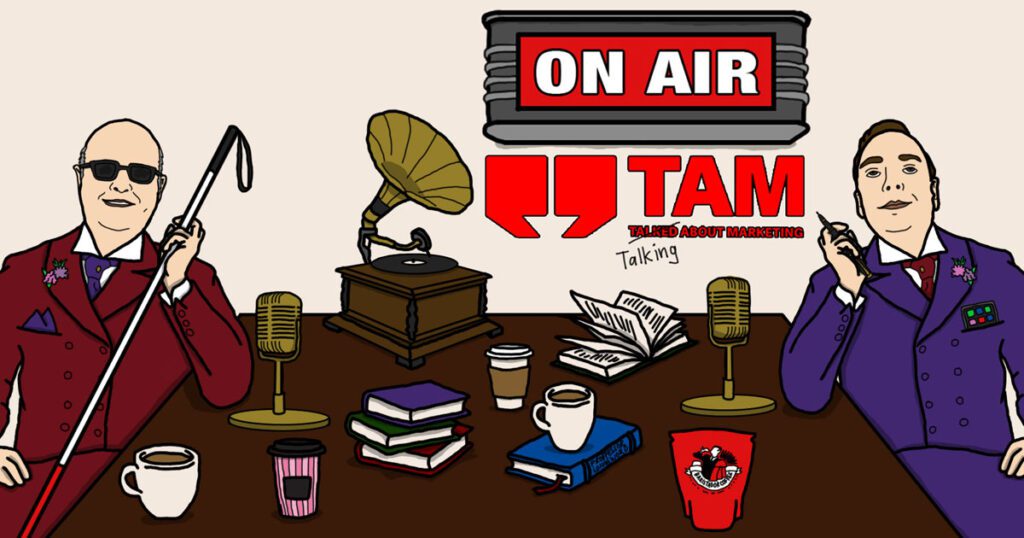
Mike Michalowicz reckons you should pay yourself before you pay anyone else, and Steve and David spend an episode working out whether that’s financial wisdom or just your grandmother’s envelope system with better branding.
Steve and David spend this episode on Profit First, the small business finance book by Mike Michalowicz. The core idea: set money aside before you spend it, not after.
They trace the system back to depression-era thrift, compare “profit” against “long-term savings” as motivating words, and work through the mechanics of running a business on smaller bank accounts and smaller plates.
There’s also a look at email newsletter platforms shrinking their free tiers, and a 1990s cider ad starring Leslie Nielsen, tested against the question of whether comedy still sells products the way it used to.
Get ready to take notes.
Talking About Marketing podcast episode notes with timecodes
01:45 Person This segment focusses on you, the person, because we believe business is personal.
Grandma Already Knew This
David put Steve onto Mike Michalowicz’s Profit First. Before the mechanics of the system, they discuss its origins: the envelope method, setting money aside for bills the moment it arrives, which Michalowicz traces to his mother’s own budgeting. Steve and David connect this to a habit common before entrepreneurship culture prioritised looking successful over managing money well.
Michalowicz describes a networking event where everyone tells strangers business is going great, while the same people admit to close friends that it’s hard. Steve and David discuss the gap between appearance and reality, from upgrading a car lease to keep up, to simply not admitting a business is under pressure. David notes that small, honest peer groups, ten or twelve people, are less common in Australian small business than they could be.
Michalowicz uses Parkinson’s Law as an example: smaller dinner plates lead to smaller portions without anyone noticing. He applies the same principle to money, arguing that constraint changes behaviour more reliably than willpower does.
This is an episode of Mike’s podcast, from which we take a couple of snippets.
12:45 Principles This segment focusses principles you can apply in your business today.
Set Up the Envelopes, Skip the Guesswork
Multiple bank accounts, set up like envelopes, each with a job: profit, owner’s pay, tax, and operating expenses. Michalowicz starts small, around one percent into a profit account to begin with, increasing the percentage as the habit builds.
David describes learning a version of this himself, not from the book but from a phone call to his accountant the first time a large consulting payment landed. Fifteen minutes working out percentages for tax, super, and long-term savings, and those percentages have stuck ever since. He says “profit” doesn’t motivate him as a word, but “long-term savings for when I’m seventy” does.
Michalowicz’s system also covers cutting costs without cutting capability, building a buffer under your expense target rather than aiming right at it, and the idea that debt is only paid off by becoming profitable, not by waiting until you feel ready to be profitable. Steve and David note that the book is dense with step-by-step detail that doesn’t suit audio, and recommend a print or Kindle copy for anyone planning to apply the system.
26:00 Problems This segment answers questions we've received from clients or listeners.
The Shrinking Free Tier
Email newsletter platforms have been reducing what’s included for free. Mailchimp’s free contact limit shrank over the years, MailerLite became the alternative, and then it dropped its own free threshold to 250 contacts, locking out anyone over that mark entirely.
Steve outlines the options he’s tested since: Brevo, which allows unlimited contacts but caps each send at 300 recipients, and sending newsletters directly through WordPress once you’re on a hosting setup with proper mail deliverability in place. Each option suits different circumstances, depending on whether email is a core sales channel or, as it is for Talked About Marketing, one channel among several.
31:15 Perspicacity This segment is designed to sharpen our thinking by reflecting on a case study from the past.
Puns Sold Cider, For A While
A 1990s American ad campaign for Red Rock Cider featured Leslie Nielsen reprising his Police Squad character in a pun-drenched parody called Fraud Squad. Steve and David discuss the writing, which lands product benefits inside the gags rather than around them.
The campaign won awards and drove an early sales spike, then sales faded, and the brand folded by the mid-1990s. David notes that cider as a category tends to boom and bust in cycles, in Australia as much as the US, so novelty may buy a brand its moment without buying loyalty. Steve and David discuss what that means for a campaign built on novelty and star power: it may be worth treating the spike as temporary rather than assuming it will carry a brand long term.
Transcript This transcript was generated using Descript.
A Machine-Generated Transcript – Beware Errors
S09E02
Caitlin Davis: [00:00:00] Thinking about Marketing is a podcast for business owners and leaders, produced by Steve Davis and David Oldney of Talked About Marketing. More than 8,000 conversations have taught them something. You can’t read the label from inside the bottle. Everyone needs external perspective. Through their four Ps, person, principles, problems, and perspicacity, yes, you heard that correctly, they explore marketing with curiosity, generosity, and the occasional gentle eye roll.
They hope this becomes a trusted companion on your journey in business[00:01:00]
Steve Davis: David Own, if I, uh, had a photo finish of a race and I was dressed in a toga, how would you describe me? I-
David Olney: if it was a photo finish of a race and you were in a toga?
Steve Davis: Hmm.
David Olney: Um,
Steve Davis: well, I,
David Olney: I see- Would
Steve Davis: you think of Biblical times and go, “Ah, it was the prophet first”?
David Olney: No. No. I, I, I would think of ancient Greece and that you were a good stoic and you were training hard for the day there was a lion chasing you.
Steve Davis: Ah, gee, I tell you what, it’s hard doing visual gags and puns these days. It really is.
David Olney: Particularly with me
Caitlin Davis: Our four Ps. Number one, person. These are insights for the whole person, not just the business operator. Oscar Wilde put it this way, “The aim of life is [00:02:00] self-development. To realize one’s nature perfectly. That’s what each of us is here for.”
Steve Davis: In the person segment, uh, David, you put me onto a book called Profit First by Mike Michalowicz.
It’s not the first book of his that we’ve talked about. I’m having trouble remembering what the, uh, first one was, but, um, it’s escaping me.
David Olney: I have this trouble with all his books ’cause there’s normally overlap.
Steve Davis: Yes.
David Olney: And they’re all good, but he hints at the other five you should read in every book, which is very good from a self-promoting perspective, but not so good for remembering what’s in each book.
Steve Davis: No, and the overlap is, is the key. I mean, he’s been pushing his toilet paper entrepreneur book quite a lot during this one, and- Yes … and so on and so forth. But his books are typically short. They typically get straight into the guts of what he’s talking about, and the book we’re talking about today is called Profit First.
Before we talk about it in the [00:03:00] principle seg- section so that we go straight into how you apply this in your office, worrying about profit, worrying about financials is something that impacts all small business people in their personal lives. And so I thought in the person segment, we should just reflect on this, David, because a lot of what he’s talking about is very old school, garden variety, home spun wisdom that used to be the thing, especially with the generations that survived wars or lived through depressions.
He talks about how, I think it was his mom, had a little collection of envelopes, and when she got paid at work, she would put a- an allocation here for the light bill and an allocation here for this and so on and so forth. And I think it’s in there that we have the DNA for his Profit First system. Would you agree?
David Olney: Very much. I think there’s an assumption in his books that there [00:04:00] were people who once life had taught them these things very early, but then in the, the hothouse of US entrepreneurship. But a really interesting thing with the book is when he talks about being in a network event where when everyone’s talking to strangers, they’re saying, “Oh, look, this is how this is going.
This is how this is going. We’re all doing so well. How are you doing?” “I’m doing well.” But when people are talking to their friends in private, everyone admits that it’s a bit harder. So somewhere along the line, the entrepreneurial hothouse became so focused on you have to be doing well rather than you’re working to be doing well, uh, that somehow people forgot to do the sensible things and instead started to try and put on an image that everything’s okay.
Steve Davis: And you know, this is a real danger in our society because, A, we’re geared to keep up appearances. We’re always checking where we sit in the pecking order. And there’s [00:05:00] always the assumption that what you see surface level is true. And so that whole adage of don’t judge a book by its cover really definitely should apply at your Business SA event or other networking gathering, because otherwise you might find yourself, huh, upping your lease on your BMW when you don’t really need it, because the people who have got that are often suffering pain they shouldn’t be suffering.
David Olney: And I think this is a key thing that’s often missing in small business. It’s well and good to go to a network event where you don’t know people to try and get to know some people, but not enough people here in Australia are part of or a mentorship group or a small business support group where it’s only 10 or 12 people maximum, often less, but there’s a lot more honesty about actually it’s really hard and I’m really struggling, and has anyone been through this and what did they do?
And that’s something I see far more [00:06:00] in my American job, small business people getting together and being far more honest with each other about how close to the knife’s edge they actually are.
Steve Davis: And I think, look, I take my hat off to Mike for this book because, yes, he gets carried away in parts. We’ll touch base on that in, uh, the next segment.
But, um, at the end of the day, what he’s doing is saying, “Be prudent. If you are disciplined and prudent, you can make a little go a long way.” And he, he refers to Parkison- Parkinson’s Law, uh, basically, uh, from the, um, the self-help, uh, fat loss industry. Those who follow the evidence say, if you just use smaller plates, because we are programmed to try and fill the plate that we’re serving, our move in the last few decades to bigger plates means we pile more food on our plate.
However, if you go back to the size plates used to be, which is, you know, a degree smaller, [00:07:00] you’ll actually put less food on it. And so without even thinking about it, you’ll end up ingesting fewer calories, which is something that I’m, I’m, I’m actually really toying with that idea. I think that’s very smart.
But he said the same thing happens with a tube of toothpaste. You can make a new tube of toothpaste or an almost empty or even a traveler’s airport toothpaste last three weeks if you want to. There’s just a different way you apply yourself to it. And then he’s using that same analogy with the way we use our funds in business and think about our income.
I think even in this person segment, it has relevance just to think about that mindset shift.
MIke Michalowicz: Profit First is a cash management system for businesses, not an accounting system, so we gotta be clear on that. It’s a system that runs at your bank. The reason it runs at your bank is it’s called a behavioral intercept. If you log into your bank account to see how much money you have so you can determine what [00:08:00] you can spend, that’s normal human behavior, but we need a system there that tells us what the money is available for.
So we have multiple accounts set up, like envelopes, at your bank. Minimally, we set up five. An advanced deployment of Profit First could have tons, but the, the danger is we hear, “Oh my God, like, 10 accounts?” It feels like such an overwhelm, people avoid it. So the essence of Profit First is you start slow and let it grow.
So if you wanna implement Profit First, the first thing I tell people, before even the caps and taps, I say, “Just set up one additional account at your bank, call it profit,” so it’s a savings account or whatever, “and allocate 1% of your income into it.” So if you make $1,000, 1%’s 10 bucks. Put it in your profit account, run your business off the 990 leftover, and you’ll find a way, ’cause you can run off 1,000 bucks.
You can run off 990. But you’ll start seeing profit accumulating. So the first step to implementing it is to start very slowly and just test the waters.
David Olney: It’s something I very much thought about when I went from being an academic, where I just knew each week they [00:09:00] would pay me. You know, right, it was a period where I was in a contract rather than over the long break over summer when they didn’t, um, versus once I started consulting. And, you know, the first time I got a big paycheck consulting, it’s like, whoa, that’s a bag of money.
I’m like, hang on, hang on, hang on, hang on. I’ve had enough people in my life in small business See that pile of income as, “Well, it’s all money I can use right now,” and end up in huge problems with the tax office, or huge problems later on with not having savings. So I remember the first time I ever got a big income check from consulting, ringing my accountant and, and so saying, “Hey Phyllis, how much of this should I put away for tax?
How much do you recommend I do, you know, voluntary super? How much of this should I put in long-term, don’t ever touch unless it’s for a major thing like a house savings?” And you know, she spent 15 minutes talking with me, and that day I worked out my percentages, and they’ve been my [00:10:00] percentages ever since.
So really where Mike’s talking about profit first, I realize what I did on that first day is clearly something that I’d probably learnt from my grandmothers, having been through the Depression and World War II, and that is safety first. What are your obligations? Cover them first, and only once your obligations are covered, you survive on what’s left.
Or if you can’t survive on what’s left, then you start thinking about what else you should do.
Steve Davis: So in a nutshell, Profit First is saying, look, if you have a $10,000 a month, let’s say, and depending on what sort of small business you are, that’s either disappointing or really over the top amazing. He said, “Don’t let every dollar of that money sit in your main transaction account.”
He does, does make the point that most of us in small business, we operate out of one transaction account, and we keep an eye on that, and- Mm … if, if it looks healthy, that’s good. Maybe we’ll buy that extra thing. If it’s a bit tight, eh, we’ll pull our belt in, and that’s his point. We can pull- Mm … our belt in when it’s tight.
So he says, [00:11:00] “Always allocate money first.” Uh, you’ve got to go to the, uh, money you’re paying yourself in profit, uh, the money that you’re putting aside for, uh, tax, and I think there was, uh, expenses, something else of that, of that nature.
David Olney: Well, always profit as well as income. So to see- Yes … the difference between there’s the income you need.
But really, if you can’t put a little bit away as profit. And for me, profit is not an exciting enough word. It doesn’t do anything for me. Mm. Whereas if I say long-term savings, so that when I’m 70 and I’m not working, how do I want my life to be? That’s infinitely more persuasive. So safety resonates with me far more than getting excited about profit does.
That’s probably why I like working with people rather than being a gung-ho, buccaneering, you know, entrepreneur.
Steve Davis: Yes. Well, exactly. So what’s left in that main account? That becomes your opex, your- Yeah … operating expenditure. And- Yep … you can say, “Oh, gee, I can’t afford that this time.” Yep. So it, it, I can understand [00:12:00] why some people would say, “Mike, this is not sexy.
This is not the American way of being big and brash and sexy.” But as he explains in the book, and, and we’ll come to that in the next segment- It is a case of the hare and the tortoise.
David Olney: Yep.
Steve Davis: The hare wants to rent or lease that super-duper car now, pay exorbitant amounts to have everything flashy, and live with dread when they’re quietly alone by themselves, versus the tortoise that slowly- Yeah
and steadily actually gets to a point where you can flex those muscles if you should, if you want to.
Caitlin Davis: Our four Ps. Number two, principles. These are ideas worth building on. As Oscar Wilde reminded us, you can [00:13:00] never be overdressed or over-educated
Steve Davis: In the principle segment now, let’s turn and really focus squarely on our business and see if we can pull out a few of the key points. One thing I did find, Dave, and I think you did the same thing, is this book is really hard, ’cause we listen to books, you and I.
This is a hard book in part because it’s gobbly, like rushing through specific step, step, step, step, step, and it’s not made for audio consumption. So if you are going to apply this, you probably want to have a print copy so you can work through that slowly. It’s the other narrative sections that are easy to read and listen to.
Did you agree with that?
David Olney: Absolutely. If I was a sighted person, I would be off on the attached website downloading all the relevant materials as the only way you could probably apply this while listening to it as an audiobook. And I think in a lot of ways, you’re actually better off with th- this book either having the Kindle or paper copy so that you [00:14:00] can stop and look at the pages and think about, you know, going away and doing the calculation, going away and laying out things in columns or rows as he’s describing.
Steve Davis: So we’re not gonna do justice in, in getting every specific out there, but I think if we can give you enough of the flavor of the, what he asks us to do, uh, I think you will be able to make a decision about whether or not you go down this pathway. The thing that struck me interestingly right at the beginning is he’s talking about having money set aside for this and that.
You know, the, the profit bit goes to you, and he starts with a really small percentage of around 1% to begin with, and then every quarter you might reassess that and up it just a little bit. Um, he says, “You’ve gotta use real bank accounts for this, not just leave it in the one account and trust that your, uh, accounting software or a spreadsheet is going to do the division.”
Does that, does that ring true for you?
David Olney: It does, absolutely. I remember [00:15:00] when online banking finally became easy and accessible, you know, with screen reading software on the computer and on the phone, and I loved it because I could do exactly that. I could make it easier to separate accounts out. And to me, it just made life so much simpler, jumping in every two weeks and going, “All right, this income’s come in.
This goes here, this goes here, this goes here, and in that account there.” Well, if I spend all of that in the next week, I’m stupid, but it doesn’t affect anything long term. I, I really like it from the first time I did it.
Steve Davis: And so that’s what, why I haven’t dived into it yet. I haven’t had a chance to sit down with, um, my bank and see what they can do, ’cause you said some banks will just slug you extra fees for all these accounts.
But talk to them, because they can waive them.
David Olney: Um- Well, my suggestion there is I used the online-only accounts where you manage everything yourself And most of them, as long as you put in extra money every month or maintain a certain [00:16:00] balance, are no fee.
Steve Davis: Yeah.
David Olney: So you can do this really affordably with about 10 minutes research.
That, once again, is what I really like about running multiple accounts and just going in twice a month and going, “That lives there, that lives there.”
Steve Davis: The different things you’re putting money into, the different buckets, if you like. There’s income, where money goes. Profit. There’s owner’s compensation. Th- that is the, the money that, that pays you, uh, your wage.
Uh, there’s tax, and there’s operating expenses. They’re the main ones, aren’t they?
David Olney: Mm. Yep.
Steve Davis: And one of the things that, uh, this is where having the slow down read version would be helpful, is there’s a bit of, um, nuance in this. So profit should never be confused with owner’s pay. He’s really clear about that.
David Olney: This is why for me, I, I never thought of it as profit. I thought it as very long-term savings Like that worked better in my [00:17:00] head as a, you know, as a, a visualization or an analog. And people might see profit and it works, or they might wanna say, “What do you want your life to be like at 70?” Either works.
Steve Davis: Yes.
And then he said the other thing that’s important is you don’t touch the money that’s in profit. No. And you don’t touch the money that’s in the tax account until it’s tax time and you’ve gotta pay your tax. What you do after all the money’s been allocated is there’s money left sitting in the operating expenses account.
That is where you pay bills from, and that’s it. If you don’t have much there, you have to then put your focus on expenses, which is a- another major focus of his book. He says you’ve already gotta go through and work out where you’re spending your money, because little things you can subscribe to over and over again with that and then you forget about them, they’re just chipping away in the background.
So this is about, it’s about discipline, David, isn’t it? It’s about paying attention. This is almost like [00:18:00] paying attention to the cents and the dollars take care of themselves.
David Olney: Exactly. It’s very much that thing of if you pay attention to the expenses and you don’t have enough money in the expenses account, well, you’ve got a problem.
And a very big part of the book is saying that, you know, for most entrepreneurs, the solution to not having enough money in the expenses account is, ‘We gotta have more sales. We gotta have more sales.” But what I’ve unfortunately seen people do consistently is we’ve got to have more sales, but then not acknowledge that if they get those extra sales, there will be extra expenses to service those new customers.
So they magically think you can have more sales without increasing your expenses. So your expenses are already under pressure. You get more sales, well, your expenses are now under even more pressure. And very often, if the balance between sales and expenses isn’t right, it’s because either you can’t sell the product for the price you need to earn, [00:19:00] or you’re not efficient enough at providing the product or the service at a price that can allow you to be okay.
So one way or the other, the wonderful thing with his system is if you’ve got an imbalance between what you sell for and, you know, how much money is in your expense account, you need to decide, do you make your product better? Do you make your product cheaper? Because more sales alone is never the solution to the problem, unless you’ve got no sales, and then you’ve got a far bigger problem.
Steve Davis: He does use an example when he’s trying to argue that we should look at halving our expenses and doubling- what we, what our output is, what our product is. Mm. And there’s a great example of a guy who had a delivery business. They would deliver oil, and they’d have full tankers going out to top up the big tanks of jet fuel and everything.
But then they’d have other trucks that take out containers that go to your Walmart and those sorts of places. And it dawned on him one day, [00:20:00] because he’s doubling everything up, why not halve the trucks? Why not make the truck half a tank and half shelving so you can have the jars on it? And that way, a truck could actually cover, in a run, different types of customer.
Yep. And it’s … And he said, “It’s when you push yourself with this sort of rule of thumb, you have to think big and rethink the industry norm.” So everyone’s been doing it this way, but is that the right way? But when you put that little constraint on you, you could argue as an artificial constraint, an aspirational constraint, uh, it does make you
Necessity is the mother of invention, David.
David Olney: Yeah. It’s so easy to just habituate to, “Oh, this is the simple way.”
Steve Davis: Hmm.
David Olney: Yeah, but the simple way is probably not the profitable way, unfortunately. It rarely has been and rarely will be.
MIke Michalowicz: If [00:21:00] you have debt, here’s the irony. You have to do Profit First. Well- You have to be profitable, and I would suggest Profit First.
So here’s the argument I hear from people. I have debt. I have $100,000 of debt, which is, to me, an overwhelming amount of debt, and I’ve been there. I’ve been worse. The business owners say, “I, I gotta pay off my debt before I can be profitable.” Do you know the only way to pay off debt is by being profitable?
And what I mean is this, is debt is a expense you incurred in the past that you couldn’t afford, or at least chose not to afford. Right. So you bor- you used other people’s money to pay. Now you’re indebted to them. That’s what debt is. So debt means you used other people’s money in the past. The only way now to pay back that creditor is to make more money than you’re spending, AKA profit.
You have to be profitable to have that excess to pay debt. So start the Profit First system immediately. Allocate money toward profit. There’s one exception. When this profit distribution comes out, you’re not gonna use it to reward yourself. Ah. You’re gonna use it to pay off the debt.
And that feeling is kind of a reward in and of itself.
It’s
not a reward, because now you’re [00:22:00] chopping down debt. But a small portion of that profit still goes to you. There, there’s operant condition I mentioned last week. There’s reasons why we want to still reward ourselves, at least in small portions. So, so a small portion comes to us to, to empower us to keep doing profit, but also by running the Profit First system repeatedly over and over again.
And yes, we’re using that profit to pay off debt. Once that debt’s eradicated, you now have mastered the Profit First system. And when that next distribution comes out, you’re the recipient of all of it
Steve Davis: He’s got a structured approach to this, and if anything we’ve talked about interests you in any way, shape, or form, it probably is a, a book worth buying and working through and, and raising with your accountant. He does say some accountants will be quite angrily against this system, but others will be…
What’s your take in the Australian context? Do you reckon accountants are gonna be pretty comfortable with this?
David Olney: I think a lot of accountants [00:23:00] here who are already gently trying to say, “Where’s the tax money? Where’s the money for your employees’ super?” Where they’re already trying to apply that pressure, would be very grateful if people had something they’re reading and thinking about that makes that an internal pressure rather than just a pressure coming from the accountant.
That’s my suspicion anyway. Yeah. And the number of partners in the world, you know, who would be really happy if they didn’t see, you know, their life partner looking stressed all the time.
MIke Michalowicz: Mm.
David Olney: Because even though the income account looks okay, there’s no explanation of where that money goes, when it goes, and why there’s money there, but actually there’s no money for next week’s groceries because the person didn’t pay himself.
Steve Davis: So let’s have a quick, uh, whip through to, to round off this segment with some of the punchy rules of thumbs he has. One is run the business on less than it has available, as a good rule of thumb to work on. So you’re putting that profit aside, the tax aside, [00:24:00] pay the owner first, et cetera, and then working from what you have.
In fact, there’s a touch of stoicism here because we talk about the stoics quite a bit, probably you more than me. Uh, he said, “If you can cut 10 to 15% before you think you need to,” this is just pure stoicism, “you will have yourself in a more robust position for when that softer month comes,” David.
David Olney: Yep.
Practice for bad times.
Steve Davis: Yes. Yep. He wants to get the opex 10% under target. Don’t really aim to hit the target expense percentage. Build a buffer beneath it so you- Yep … you can actually pay for more if you need to. There might be a special bargain, you can make more money, uh, that way. He said, “Cut costs, not capability.”
So he’s very clear to say, “Don’t go slashing.” This is not an argument for slashing everything. This is pruning. This is pruning the things that we’re doing ’cause we think we should, not because they’re actually productive assets.
David Olney: And a big thing [00:25:00] in the book, because the original version of the book is probably a decade ago, and this is the updated version-
Steve Davis: Yes
David Olney: is how quick people wanna move to the better office, the nicer office furniture. The nicer laptop for when you go to meetings, the nicer suit, the nicer briefcase. At some level, sometimes you need those things that set image. They’re really important sometimes. But in an awful lot of cases in small business, they’re far less important than you think they are, and it frees a lot of money to not get too sucked into the status game.
Steve Davis: The other thing he says is the bank balance is not your budget. Nope. That’s why he has that discipline of putting money in lots of different places. So they’re probably the main things that spring to me. I’m sure there’s more, um, but, uh, Mike Michalowicz has produced another helpful little book.
David Olney: Absolutely.[00:26:00]
Caitlin Davis: Our four Ps. Number three, problems. These are the marketing challenges keeping you up at night. As Oscar said, “We ask questions for the best reason possible. Simple curiosity, no hidden agenda, just genuine interest in what’s actually happening.”
Steve Davis: In the problem segment, just something that I’m having to c- um, change my advice now, David.
Heaven forbid, the world changes. Uh, in the beginning of time, anyone who’s been with me for, like, 15-plus years will know that I was a great fan of Mailchimp. Uh, they let you have, I think at one point it was up to 2,000, then it was 1,000, um, uh, contacts in your email list for free, and you could send them a, a message every month, and everything was sweet for the small business owner.
And then if you did have an explosion of numbers, then you could afford to, and justify putting the money aside to that subscription. Even [00:27:00] Mike, Mike Lewitz might agree, because you would hope your newsletter’s being productive and earning its keep. Then they got greedy. They did chop it down to 1,000, and I think then they went to 500.
Meanwhile, MailerLite, L-I-T-E, came on the scene, and they became my new darlings. So they let anyone to have up to 1,000 people in your contact base, and you could still send emails for free. They were basically the same as Mailchimp, and, uh, you know, seems to work very well for those of us who wanted email newsletters.
However, uh, last week, David, I went to send out a Talk About Marketing newsletter. We were using MailerLite, and it said, “You’ve got more than the 250.” They now, they now dropped it to 250. Uh- Yeah … but because you’ve got more, all the functionality is locked. They won’t let you just send to that 250 and, and leave some [00:28:00] change.
Uh, you’re locked out, and it’s r- there’s not a lot you can do. And look, the newsletter’s important, but it’s not in our particular business model. Uh, we do a lot of different connection and different networking. This is a nice-to-have and a way of communicating with our people. It’s not our number one tool, and so following Mike, Mike Lewitz’s advice, I don’t want to be racking up another, uh, um, subscription.
So I had been using Brevo, B-R-E-V-O. They’ve got a different model. They let you have as many people as you like, but they limit you to no more than 300 emails per send. So let’s say you had 1,200 people in your database. Uh, you can just divide them, just put a little code next to their name. You know, like when you’re at a networking event and they go around, they number everyone, one, two, three, four, one, two, three, four.
[00:29:00] Everyone in group one gets emailed, everyone in group two. If you’re really wanting to keep very frugal with your newsletters, Bravo, uh, Brevo, um, does a pretty good job at that, or you can just pay if you want to. But also, because we have moved to Talked about marketing’s brand new web hosting that we’ve got, which is virtual private servers.
It’s really robust and strong. So I gave a, a try to the newsletter plugin within, um, uh, the WordPress environment, and because we also have a post haste setup which guarantees connectivity between our website and the outside world with high trust, it became a wonderful way for me to send a newsletter.
If you received our newsletter in between this episode and the previous one, that was sent from within our, within our own WordPress website. I probably wouldn’t use it, David, if I was just on shared web hosting at your, you know, Venture IP or those places because, um, you know, in [00:30:00] shared- There
David Olney: would be security issues somewhere, sometime
Steve Davis: yeah, and overload and all those sorts of things. Mm. But in this new environment, it worked an absolute treat. So I just wanted to put it out there, uh, for anyone who’s toying up and hitting this, um, ceiling, by all means, just pay MailerLite and go on your merry way, or, uh, consider Brevo, B-R-E-V-O. Or if you have moved into our YouBeauty hosting, uh, or some other form of virtual private server so you’ve, you’ve got good robust, uh, stuff under the bonnet, then the newsletter plugin within your own WordPress website is a nice way to move forward.
Uh, one trap for young players, the subject line had a default word zen in there, which I didn’t see, David, and so I don’t know, this might be why the newsletter got opened even higher rate this last week, is I was promising zen, uh, and so people-
David Olney: Yeah. I remember [00:31:00] kinda going, “Oh, that’s odd,” and then moved on to my next task.
Steve Davis: Well, peace be with you, David. Peace be with you.
David Olney: Well, see, I was very zen about it. I just sort of kept raking the, the rock garden, and everything was groovy.
Caitlin Davis: Our four Ps. Number four, perspicacity. Let’s examine a campaign from the past and ask, would it work today? As Oscar Wilde believed, our one duty to history is to rewrite it. So let’s see what we can learn.
Steve Davis: Finally, in Perspicacity, we look at an old advertising campaign, and we wonder out loud whether it would work today.
And something that’s been shared a lot in my social media feed of late is a campaign for Red Rock Cider from the USA, with the actor Leslie [00:32:00] Nielsen recreating his role of, uh, it was Inspector Frank Brennan from Police Squad. He was in those crazy pun-drenched movies, as you heard at the beginning of this episode.
Puns, not necessarily our shtick, David.
David Olney: Particularly not me. I fail at puns quite regularly, much to your chagrin.
Steve Davis: Anyway, uh, they’ve recreated his world to s- of, of police, they called it Fraud Squad, and he goes out, and let’s have a little listen to this one. I’ll put the actual YouTube video in the show notes.
TV Ad: Tonight’s episode, The Secret Assignment
I’m going to the bar, Al. Cover me[00:33:00]
What can I get you?
Screwdriver
Anything to drink?
What’s that?
Just cider.
This isn’t just cider. Fraud Squad, hold it, sister
This is Red Rock. You see, it’s less gassy with no strong aftertaste. It’s a different kind of cider altogether. It’s less gassy with no strong aftertaste. It’s a different kind of cider. Book her, Al. Are you available on the 15th?
Red Rock Cider. It’s not red, and there’s no rocks in it
Steve Davis: David, it’s one gag after another, but landing the selling points of the cider and, you know, and using his own pun when he says, “Hey, say blah, blah, blah,” and then it gives them a, a, a chance to repeat the line.
David Olney: Mm.
Steve Davis: Which is a bit cheesy if you were just doing a [00:34:00] normal ad that way, but completely within the Frank Brennan-
David Olney: It works brilliantly.
Yeah, look, the, the quality of that writing that that’s for an ad is like, wow.
Steve Davis: Yeah. And, and cover me, and he puts a blanket over him and the-
David Olney: Yeah …
Steve Davis: the pool table. And the
David Olney: pool table, and the screwdriver here. Even the sound effects of hearing the screwdriver of fixing the stool.
Steve Davis: So what, what do we take away from this for someone contemplating an advertising campaign today?
Because something that he, that had in favor of it is Flying High was Riding High, Police Squad was there, it… Naked Gun. It, I mean, would’ve cost a pretty packet to actually have- Mm … him do this. So you imagine this is a mass consumer brand that could recoup that. But we all watched the same things a lot more, so the currency of the character and the gags and the schtick would’ve been high.
He would’ve brought attention. I’d be curious to see what this did from a sales perspective, but [00:35:00] society was geared differently. I wonder if it’s, there’d be fewer candidates for this treatment today.
David Olney: It’s really good in terms of novelty, and it’s really good in terms of even if you didn’t pay attention to the first gag, maybe you would pay attention to the second gag.
So even though we would’ve all had film and TV in common, you know, when that ad came out, and we don’t now, the sort of level of neurological stimulation and novelty and the fast pace, and you can miss a gag and get the next gag, I, I still think it could work reasonably well today e- even in an era where, you know, he’s not widely known.
Yeah, you could probably do it with an unknown and just be quirky like that, and people would go, “Hang on, what’s this different thing?” Well, that’s a gag. Well, that’s another gag. Oh, look, that’s a visual gag. Oh, look, that’s a, a pun. That’s a– For anyone who likes comedy, I think this is still magnetic.
Steve Davis: [00:36:00] Interestingly, I just had a look at a brief bit of research, and so what happened here is it leapt out of the gates really strongly, Red Rock Cider.
David Olney: Mm-hmm.
Steve Davis: It, it, it hit the straps. But as the campaign faded, so did sales. And mid-’90s, they folded up shop. They were no more. And so the summary is excellent ads.
They won awards for the ads. Mm. But limited long-term brand and product success.
David Olney: And i-if we look at cider in Australia, let alone in America, cider has a year, and then it’s nearly dead, and then it has a year, and it’s nearly dead. Like, the last big cider phase was about twenty nineteen. We’re probably due for one again, and each time it’s different brands.
Steve Davis: So maybe you need the novelty to cut through, but you need to make sure you’re making your money upfront really quickly.
David Olney: Yeah, make your bucks and run away, I think is the thing here on the ad and on cider.
Steve Davis: Surely, you can’t be joking.
David Olney: Surely, you can’t be serious. Surely.[00:37:00]
Caitlin Davis: Thanks for listening to Talking About Marketing. If you found this helpful, please share it with someone who might benefit, and if you’re so inclined, leave a rating in your podcast app. Both help more than you think. Steve and David welcome your thoughts, which you can send to podcast@talkedaboutmarketing.com.
That’s podcast@talkedaboutmarketing.com. Want to continue the conversation beyond the podcast? You can book 20 minutes with Steve at talkedaboutmarketing.com. No cost, no obligation. And we’ll leave the last word to Oscar Wilde, “There’s only one thing worse than being talked about, and that’s not being talked [00:38:00] about.”