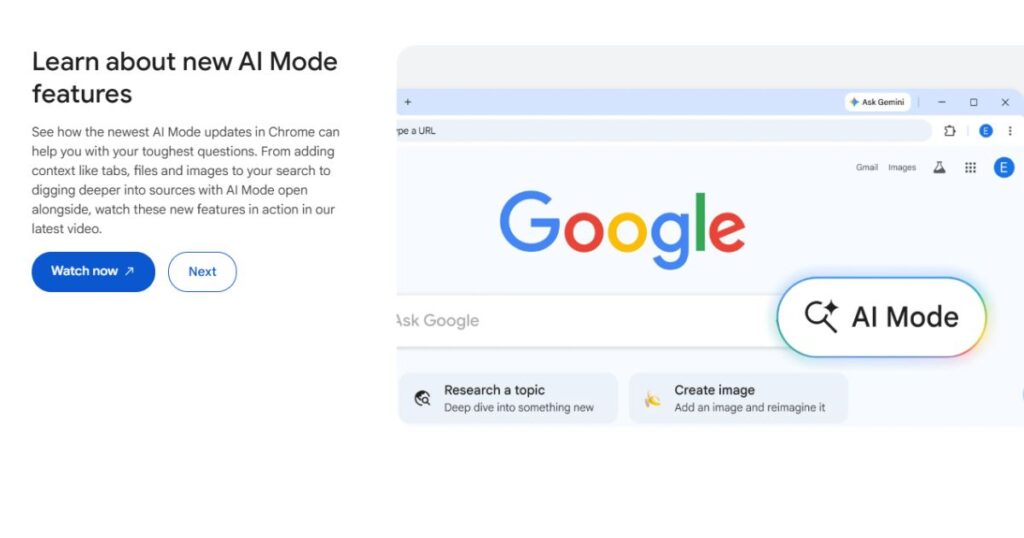
My Chrome browser just updated and before I could do anything it had pushed its latest “welcome” screen. This one was forcing AI down my throat like a severe parent not letting their children leave the table until every last bit of broccoli has been eaten.
What is going on with the “tech bros” and the “wannabe” tech bros? Every single digital offering is now boasting AI capabilities and, more often than not, inserting nagging “try AI” buttons throughout the user interface. It feels like these creepy companies have all drunk the same Kool-Aid, have all been reading the same “fad daily” reports, and have decided to persistently have their AI buttons loiter like predators strolling around schoolyards. It is insidious.
The main image for this article shows Google’s latest push to Chrome users, “enticing” us to, “learn about new AI Mode features.” Not content with hoarding our search data to enable goldmines of Google Ads, now it really wants to tie its offering into our search and website usage so it can feast its greedy eyes on our intentions and queries at a sub-granular level.
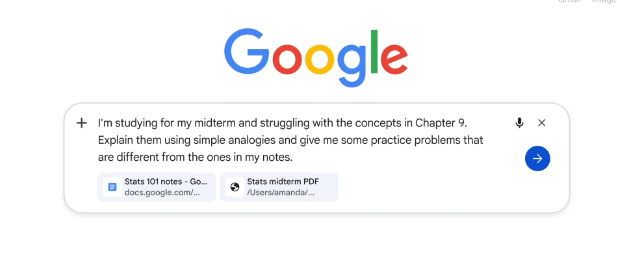
Google now wants us to stay in its browser and run our AI questions and prompts there. Fine, you might say. Makes life easier. But it does edge us further and further from the important process of having to “think for ourselves” about a problem and set of questions. The more we rely on AI for conceptual thinking, the more that skill will shrink.
The People Have Had Enough
We use AI tools in our workflows these days. But we use them in what we deem to be a thoughtful, hybrid manner to help execute our original thinking and activity with extra speed. Not all of it. The thinking is still human. My writing of blogs like this remains human. But gathering some extra research leads, replicating or conducting an activity that is repetitive, once its fresh parameters have been set, that is amplified or sped up with some AI support.
But, increasingly, there are areas where we draw red lines, and advise clients to do the same. One of them is making flyers or posters. There is a definite increase in angry push back from consumers (fellow humans), when they see flyers that look the same as every other flyer with all the cheesy, cutesy, AI tells.
No doubt that was part of the motivation that led this young woman to disrupt a Canva forum in the UK.
I do empathise with her. This is particularly because Canva just reduced some of the value of my Pro account due to cost overruns for luring uses into their costly AI buttons and add-ons. For a company that was so smart for so long, their headlong rush into AI integration has struck me as one of the dumbest moves I’ve seen. It is like such companies get head spins when they hear the term AI, start dribbling over the prospect of ten-ex-ing their businesses through the fad, while losing sight of the core values that made their product, well, valuable.
And who pays the price for this greed frenzy? We do. Users who get plenty of value without using AI buttons to transform themselves into 80s-style trash models.
I Can’t Take It Any More
AI tools are great for adding a little speed and, when prompted correctly, offering a feedback loop to test ideas. But no matter how many books and web pages they have sucked into their vast databases, they still run sums to distil output that averages out what the next likely word or element should be, using probability within its systems.
It gives us ourselves back, in a watered down, averaged soup that is passable and even palatable, but is rarely going to be pioneering.
The truth is, we can have our cake and eat it to. We just need self-awareness. We need to watch ourselves with its use; all things in moderation includes AI things in moderation.
And I predict that the more the tech companies push this upon us and bake these settings in, the more we’ll be getting reactions similar to news anchor, Howard Beale (Peter Finch), in the movie, Network, from 1976. Methinks it is worth watching again.