
Last night in Victor Harbor, I ran a 2.5-hour workshop for Business Victor Harbor on one brief: more money in the till. This post is the record, capturing key ideas, examples, and action, in the order I covered them.
Every sale comes down to three jobs: Get found. Get chosen. Get paid.
Where The Name Comes From
Talked About Marketing takes its name from Oscar Wilde: “There’s only one thing worse than being talked about, and that’s not being talked about.” I open every workshop with Wilde, and this one got a second quote, because it describes small business so well: “Nowadays, people know the price of everything and the value of nothing.”
Picture the quote you sent last week. You pour effort into a product or service, you know exactly what goes into it, and a customer says, “That’s too dear.” They can see the price. They can’t see the value. Our job is to bring the value to the surface.
The Basics Where Money Hides
Fads and trends get the attention, and the little basics get skipped. After twenty-odd years with small businesses, my own and the ones I mentor, I keep finding the money sitting in those skipped basics.
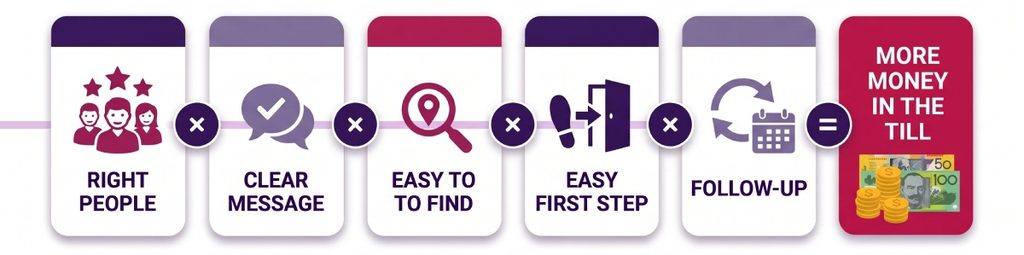
So we dotted the i’s and crossed the t’s. Five factors, one formula:
| Factor | The idea | Your next action |
|---|---|---|
| Right people | You can’t speak to everyone, and your customer isn’t you. | Name the one customer type you most want more of, and the problem they bring you. |
| Clear message | Customers want their problem named, in their words. | Get someone else to interview you, then send me the transcript. |
| Easy to find | Be the clearest, most useful answer wherever people look: Google and Maps, AI answers, social. | Make your name, address and phone number identical everywhere. |
| Easy first step | Offer a small, valuable taste before the big purchase. | Write the smallest thing a stranger could say yes to. |
| Follow-up | Stay helpful after the sale. | Fish Every Day: one genuine message to one person. |
The Circle Around The Formula
Every business person worth their salt talks about those five. Three more ideas sit around them, and they came out of my podcast with David Olney, who spent 15 years teaching Complex Problem Solving at the University of Adelaide. We make Talking About Marketing partly to keep ourselves honest: it makes us read, or listen to audiobooks, to stay fresh.
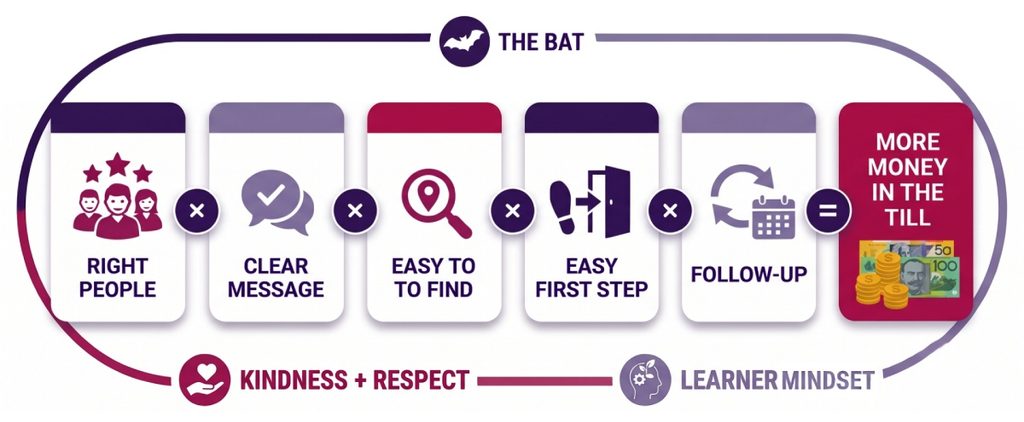
The bat. On Instagram I stumbled across a clip of the philosopher Thomas Nagel discussing his 1970s paper, “What Is It Like to Be a Bat?” We discuss it in this episode: What is it like to be your customer. His point: I have some idea what it’s like to be a friend, because we share experience. I have no idea what it’s like to be a bat. Nothing shared to rest on. Now think about your customers. We make so many assumptions that we know them, that they’re just like us. Often they aren’t.
Kindness and respect. David made the point that decades of psychoanalysis, counselling and research say most people respond warmly to kindness and respect. Business rarely talks about it. You can have a great product and a fair price, and I might buy once. But I won’t be in a hurry to come back if you weren’t kind and I felt no connection.
The learner mindset. Marilee Adams, author of Change Your Questions, Change Your Life, describes a learner mindset and a judger mindset. Say someone spills a drink. The judger asks, “Why did you do that?” and everyone feels horrible. The learner asks, “How did that happen? What led to that?” No judgment, just curiosity. It matters with customers, with staff, and with yourself, because sometimes we’re not kind to ourselves either.
At Talked About Marketing, we believe business is personal. I hate the saying “it’s just business.” It’s humans engaging with humans.
Write For Yourself First
I often urge people to blog, and I almost don’t care if anyone reads it. Trying to work out a helpful way to solve a customer’s problem is superb professional development. It sharpens the saw, as Stephen Covey would say. The readers are a bonus.
Try this: Look at the five factors. Which one makes you wince a little? That’s where to start.
Right People, Clear Message
Your customer is the hero. You’re the guide.
StoryBrand In Five Minutes
Donald Miller used to work in Hollywood writing and editing scripts. When he crossed into business marketing, the first thing he noticed was that businesses had it wrong. They cast themselves as the hero. The hero is the customer, the one on a quest, trying to achieve something. Your job is to get out of their way and be the guide.
I discovered the StoryBrand Framework a bit over eighteen months ago and have taken a few hundred businesses through it. It works because it pulls us outside ourselves, so we can look back at our business from the customer’s side. For larger organisations I interview some of their customers and stakeholders, straight from the horse’s mouth.
The framework has seven steps:
- A character wants something. That’s your ideal hero. Most businesses have more than one, each on a different journey.
- They have a problem. Problems come in three kinds. External ones, like an alarm that keeps beeping. Internal ones, gnawing at you at 3am. Philosophical ones, where you believe something should be the case and it isn’t.
- They meet a guide. That’s you, with the expertise to help.
- The guide gives them a plan. A simple, clear path from “I’ve got this problem” to “this guide might help.”
- The guide calls them to action. Call, book, order.
- The plan helps them avoid failure.
- And leads to success. A better future.
The StoryBrand video we watched puts your role this way: you want to be Yoda to your customer’s Luke Skywalker. It also says the average consumer meets around 3,000 commercial messages a day, and most get ignored. (That’s the video’s figure, not mine.)
People care about what’s in it for them. It’s their world and their problem. StoryBrand also helps you isolate a tagline, a short summary of how your business solves something in their world. A tagline works like a compass with a north marked on it. When you wander, you can see which way is back.
At this point, we did an interview exercise to help business people get out of their own heads and into the minds of their customers. The transcripts of such help guide us to a StoryBrand Framework for them.
Two Before And Afters
Apex Plumbing.
Before: “Apex Plumbing, Quality Craftsmanship Since 1999. We are a family-owned business utilising state-of-the-art diagnostic equipment to service the south.”
After: “Fast plumbing repairs without the hidden fees. Burst pipes and blocked drains ruin your day. We arrive on time, fix the issue fast and give you a fixed price before we start.”
Anyone who’s hired a tradesperson knows you never quite know how big the bill will be. The second version speaks to that.
BAS advisory.
Before: “Comprehensive financial and BAS advisory solutions, empowering local enterprises with scalable ledger management and strategic compliance oversight.”
After: “Stop stressing about tax time. Get your weekends back.”
For my first ten years in business, every three months I lost a weekend to my BAS because I could never find one receipt. That second headline spoke straight to me.
Why Someone Else Has To Ask
We are all too close to our own businesses, which is why using someone else to interview you is invaluable, As we always say, you can’t read the label from inside the bottle.
An interviewer with the learner mindset switched on can help you reach clarity. No judging, no fixing, just curiosity and follow-up. A good, wide-ranging set of questions will pull out:
- the story of how you came to this work
- the exact problem customers arrive with, and what frustrates them about your whole industry
- the question they’re afraid to ask
- who you’re not a good fit for
- what happens, step by step, once someone hires you
- how customers feel before and after
- an early mistake that changed how you treat people
- the words you use every day, and the words you refuse to use
- why you run this business where you do
That’s the raw material for a StoryBrand: the problem in your customer’s words, your plan, your voice. You’d struggle to produce it staring at a blank page, because the page doesn’t ask follow-up questions. A curious person across the table does.
Easy To Find
Two factors down, three to go. Getting your message out of your head took care of Right people and Clear message. Now to the practical half.
Three Places People Look
Sometimes someone wanders down the main street and sees you. Sometimes someone at a party recommends you. Both still happen. From the digital side, people look in three places:
- Google and Google Maps. Maps keeps getting more eager to help, sometimes a little too eager.
- AI answers. Google now puts an AI section at the top, wanting to chat with you and give a result, often without anyone clicking through to a business. Plenty of people go straight to ChatGPT, Claude or Perplexity instead.
- Social media. I have a love-hate relationship with it. It used to be a wondrous place for connection, and a lot of it is now drive-by arguments. But it’s still baked in as a communication network for most of us, so we’re better off adding helpful things to the conversation and getting known that way. It’s how people discover you and refer you.
My Triage Order
When someone sits down with me for mentoring, I check these in order of importance: website, your list, reviews, social, ads. I only touched on each in the room, so here they are properly.
1. Your website. Do you have one, and what’s the content like? Skip the “we’ve been building sheds since 1970” content. Aim for the sort of content that arises from the named problems in the StoryBrand exercise.
I still argue for a website even though some people say they only need social media. That’s a recipe for disaster. Mark Zuckerberg can switch you off in a moment. TikTok can disappear if governments get unhappy. Microsoft owns LinkedIn. That’s rented land. Meta has just started selling paid Meta One subscriptions in Australia, with business tiers from AUD 22.99 a month, and paying a platform doesn’t make it yours.
A website is hard to take away. It’s also where Google goes, and where ChatGPT goes, for the single source of truth about your business. You need that patch of turf online where you put down everything about yourself that’s accurate.
2. Your list. Do you have an email list of people who want to hear from you? More on that in the Follow-Up section.
3. Reviews. In 2026, Google reviews (and TripAdvisor, if you’re that sort of business) are where ChatGPT goes to understand who you are. It balances your content against what people say about you. Reviews are a poisoned chalice, because people can vent there too. They’re imperfect, and they’re being used, so think through a process to encourage them if you have a good relationship with a happy customer. More below.
4. Social. One or two platforms, done well. More below.
5. Ads. I’m not a big fan of advertising. Sometimes you need it: when you’re in a hurry to get a message out, establishing yourself quickly, or keeping a low-level pulse of presence going. But here’s my rule. Don’t spend one cent on advertising until your website and its content are right. Both Google Ads and Meta ads check the page you send people to, and if it’s disconnected or discordant they can refuse your ad or penalise it, so it shows less than it should and costs more.
And never send ad traffic to your homepage. Build a dedicated page inside your website, the right destination for that ad. So much money gets wasted on people clicking an ad, landing on a homepage, thinking “that’s not what I expected,” and leaving.
I don’t get excited about anyone’s social media or advertising if the first three aren’t right. People might contact you through social, but ultimately you want them engaging through your website or a phone call.
What AI Is Showing Your Customers
People are increasingly searching with ChatGPT, Claude or Perplexity. (I like Perplexity.) I ran three searches for plumbers in Victor Harbor, because humans phrase things differently:
- “Best plumber in Victor Harbor”
- “Who should I call for a burst pipe in Victor Harbor?”
- “Emergency plumber near me, Victor Harbor”
Three wordings, three different shortlists. One business topped the first search and slipped to third on the second, while another climbed to first on the third. The answers carried wrong logos. The searches that mentioned emergencies surfaced businesses advertising emergency work, and the general search surfaced businesses listing a broad range of services. This is why working out your ideal hero and their problems matters so much. Specific language gets matched to specific questions.
Asking the same question three ways is the easiest test you can run on your own category. Pick the question your best customer would ask, rephrase it twice, and see who gets named and what they say that you don’t.
A warning about what you’ll see. AI still makes things up, and it’s sycophantic. It will tell you your idea is the best. If you use AI in any shape or form, always push back. When I’ve developed an idea, I tell it to play devil’s advocate and rip the idea to shreds. It often uncovers useful things. Think of AI as an intern who has read every book in the world but has no lived experience. You still take responsibility for how you guide it.
Keywords, Held Lightly
Someone in the room asked whether we should load descriptions with keywords. I hold the word lightly. We’re not back in the old days of stuffing a page with keywords, where a cafe’s page said something like: “Our cafe in the town is the place for coffee, where you can enjoy coffee in a cafe environment, because the coffee is good.” Nobody wants that, and the tools see through it.
What matters is the deeper idea from StoryBrand: what problems are people trying to solve, what are they looking for, and what real language do they use for it? These tools soak up more nuance than the old search engines, so well-crafted writing gets picked up.
I’ve said it my whole career: do it for humans first, and Google follows. Now AI follows too. If we earnestly try to help our people in our marketing, the rest falls into place. We’re not good at that part.
What Google Says (It’s Reassuring)
Google’s guidance is the best news of the night. The basics still matter, and not a lot has changed. On its AI features page, Google says there are “no additional requirements to appear in AI Overviews or AI Mode, nor other special optimizations necessary,” and that you don’t need new machine-readable files, AI text files or special markup. It does add that nothing is guaranteed. The basics it lists:
- Be helpful, with people-first content. The best marketing leads by trying to help. We’re earnestly trying to help our people solve the problem they’re wrestling with or reach a goal. It depends on your business: in a mortgage business it’s achieving something, but it can also be dealing with the worry of where to start with a small deposit.
- Use text that can be read. I’ve built more than a thousand websites, and I’ve heard many people say, “I don’t want many words, just a few pictures.” Pictures are a lazy way to bang a site out, and they don’t cut it. These tools, as smart as they are, are still dumb. They need text.
- Give people a quick overview on the homepage. Let them think, “That’s where I need to go,” and land on the part of your site that’s right for them.
- Craft a page for every different thing you do. Unless you do 2,000 things, you’ve got a handful of discrete ones. Think of a library. If you want to bake scones, you grab the scone book, even if a chapter sits inside All Things To Do In The Kitchen. A website that’s all one blob is unlikely to be favoured by a search engine or an AI bot. A separate page makes it easy for a harried bot to know where to send someone.
- Make sure your site works on a phone. More people research on their phones, especially when you’re a destination. (Big purchases are different. I’d probably research curtains at a computer, but plenty of people still don’t.)
- Provide a good page experience.
- Keep your Business Profile up to date.
Match Your Details Everywhere
One discipline to take away. Tonight or tomorrow, check where your business name, address, phone number and contact details appear. Are they identical on your website, your social pages and your Google listing?
If one place has “08” in brackets and another drops the brackets, you might think, “Eh.” That small difference dilutes how you appear to the search bots. The industry shorthand is NAP: name, address, phone number. The advice from every institution and their dog is identical, identical, identical.
Will a mismatch destroy your business? Probably not. It’s death by a thousand cuts, and this is one of the cuts. One example from the room: a business had added its town to its Instagram name, because there wasn’t space in the description, but its Google listing carried no town. I’d apply the same name to the Google listing too, though I warned that Google can be pedantic about name changes and may ask you to verify yourself again. If your social handle can’t carry the town, a profile description or a highlight named after your town can.
Answer Nuggets: Chop Up The Food
When you feed guests, most cope with whatever’s served. An elderly guest might need their food chopped up. AI tools need their food chopped up.
So at the top of every page on your website, add what’s called an answer nugget. It’s a widely recommended habit, though not gospel. Typically it’s 30 to 50 words that say plainly what the page is about in relation to your business. AI tools love establishment years, a phone number, your distance from a landmark, a colour range, whatever the key fact is about that page. They don’t like fun or fancy words.
I put mine at the top of the page, indented and in italics. A human can skip over it to the StoryBrand copy I’ve written for people, while the AI tool gets the plain core facts. Some humans prefer it too. A template:
[Business name] is a [type of business] in [town, state]. Established [year]. [Two or three facts with numbers.] [Distance from a local landmark.] This page explains [the one question it answers].
I’ve written a full post on this, called generative engine optimisation, or GEO.
And use your customer’s words wherever you can. Part of creating a StoryBrand is learning to talk the way your customers do. When someone sends you a lovely review, or describes what you do in a different way, borrow that wording. It’s how other humans will talk about you too. It’s all just being useful and helpful in ways that make sense to them.
Your Google Listing
Google’s own help page says local results rest on three things:
- Relevance: how well your listing matches what someone searched for.
- Distance: how far they are from you. Not much we can do about that one. If you’re closer and relevant, you’ll rank above someone else.
- Prominence: how well known you are, which comes from references to you elsewhere.
That last one is where business directories help, and where friends or colleagues with a legitimate reason to mention you in a blog post can help too. Google also says to fill in your profile as completely as you can, verify it, keep your regular and special hours current, and use photos and videos to show what you offer.
Use real photos, on your listing and your website. Skip the AI photos. The Just Eat example from this month makes the case. Just Eat UK trialled AI-generated menu pictures for restaurants without photos, and the results included fried eggs and sausages floating in cola and sushi rolls filled with cheese. Just Eat apologised and paused the trial. That’s someone climbing on the horse and letting it ride itself.
I do use AI images in two cases: a cheap, quick illustration in a workshop like this, where it doesn’t matter, and an abstract blog illustration. I’m not going to climb a tree and risk rabies for a photo of a bat!
Reviews: Ask, Reply, Use
Ask. If you’ve got a good relationship and they’ve had a good experience, ask for the review. It helps a lot.
Reply. Reply to every review, good or bad. You’re answering that person and everyone else who reads it. Take the learner mindset: no aggression, and encourage connection. When you reply to a good review, work in a meaningful phrase or two from your StoryBrand. AI tools read reviews, and you want them to see something more useful than “lovely cafe” or “great beautician.” You get to put your key phrase directly in front of the tools reading your reviews. Don’t be heavy-handed. Do it in a StoryBrand way.
How to handle the negative ones depends on the situation: a nuisance person misusing the system, or a valid complaint, each calls for a different reply. I ran a workshop on this for the Tourism Industry Council, and it’s covered in its own post.
Use. I don’t like a page on a website called “Reviews.” I won’t read it. It’s the Walt Disney version of your business. Use reviews where you’ve got a genuinely unexpected one, and set it into your copy like a quote that jumps out of the bushes. Skip “Had a lovely coffee, it was lovely.” Look for something that hijacks your attention and lands a message. For a menswear shop, imagine a review from a man who drives up from Adelaide to get all his shopping done in one hit. That’s a review I’d want to see.
Cherry-pick the unusual ones, the ones that wake the reader up. Man bites dog. The saccharine ones aren’t worth the space.
Someone raised a fair worry: anyone can write a testimonial on a website, so how would visitors know it’s real? That’s why Google reviews carry weight, because they come from a person’s own account. And most of us can tell when an owner has written their own. Self-written reviews are as bad as that AI slop site. A well-chosen real quote, used sparingly, beats having none.
One caution. If you’re a registered health practitioner, check Ahpra’s testimonial rules before you quote a review in your own advertising. Comments about clinical results or treatment count as testimonials, and republishing reviews on your own website counts as advertising. Comments about service or communication are fine.
One Or Two Platforms
Social media is stressful because there are so many channels, and workshops like this parrot on about millions of them, so you feel the fear of missing out. I say pick one, or two if you must, and do them well. A solid presence where you’re alive beats being thinly spread everywhere.
I use Facebook and LinkedIn for my business, because of the nature of what I do. For others, Instagram dominates.
A seed to plant about TikTok. I’m not a huge fan, but credit where it’s due: its algorithm for connecting users to content they’ll find interesting is scarily accurate and fast. Watch a few videos and it knows what you care about. I mentored an insolvency consultant who makes what may be the most boring TikTok videos on the planet: he stands in his garden, holds a sheet of paper, and talks for minutes on end. He has about 9,000 followers, and he gets business. The platform knows he’s a business person and knows where its users’ lives are at, and it joins the dots. That scares me, and it’s worth considering, especially if you already make vertical video for Instagram. Adults are on TikTok too. The cost is mainly privacy.
If you’re stuck for what to post, start with the question your customers are too afraid to ask. It’s a wonderful starting point for social or blog content. When someone finds you, whether through a referral or by chance, you’re talking about their problem. A cafe that also sells other things, for instance, could address the coffee snob’s quiet fear: is the coffee going to be good, or is the effort going elsewhere?
Try this:
- Check that your name, address and phone number are identical on your website, socials and Google listing.
- Ask an AI tool the question your best customer would ask, three different ways. Who gets named? What do they say that you don’t?
- Fill in and verify your Google listing, check your hours, and use real photos.
- Add a 30 to 50 word answer nugget to the top of your most important pages.
- Pick one social platform, two at most, and write your answer to the question customers are afraid to ask.
Easy First Step
They’ve found you. Now, how do they make the first move? How do you get the first sale, or even the first connection, the first snoop around?
The Monkey’s Fist
On the podcast, David made me read a book by David Sandler, of Sandler Training, You Can’t Teach A Kid To Ride A Bike At A Seminiar. It describes a thing called a monkey’s paw, or monkey’s fist.
Big ships have enormous chains and ropes. If you threw one to the person on the wharf to catch, they’d be injured. They’d end up in a moon boot. So there’s a small knot, the monkey’s fist, on a thin rope connected to the big one. They throw that, the wharfie catches it, and then they can pull in the big chain.
Sandler says this is the perfect analogy for sales. The story goes that a consultant in air conditioning and refrigeration went after a big job, worth hundreds of thousands of dollars at a large complex, against established players. He told the client, “I’ve looked at the tender. I’m worried some of the things you’ve asked for, you don’t need. If you’re interested, for $10,000 I’ll audit exactly what you need, so you can tighten it up and not pay for anything unnecessary.” They said yes. And guess who got the big job? That audit was his monkey’s fist, a small purchase that opened the way to a larger one.
What does this look like in your business?
- A cafe: a free coffee card.
- A tradie: a fixed-price quote, which deals with a lot of the worry about cost.
- An adviser or therapist: a free 20-minute chat. You’re sharing something personal, so people want to see what you’re like first.
- A retailer: a small sample.
I want a real, valuable taste, with no tricks. Ponder it, especially if you’re awake at 3am: what are the small things that get people into your world and give them real value?
If You Sell Online
A few points for anyone with products for sale online.
Rewrite the manufacturer’s description. If you don’t make the product yourself, don’t paste in the supplier’s words. I was once in a chat room with a Google engineer when a store owner asked why her online shop wasn’t ranking. He said, “You’ve got exactly the same description as millions of other retailers. Why would you be number one?” Now that you have a StoryBrand, rewrite those descriptions with your own experience.
Bring your lived experience. AI with your StoryBrand will sound much more like you, but it still doesn’t have your lived experience. Google’s ranking guidance asks for authority and experience. So write about examples from your world. A skin-care client who reacted badly to certain products, the questions you had to ask before going further, the things that surprised you: that’s what builds authority, and it’s what nudges a page up.
Use real photos. See the Just Eat story above.
Write for the painkiller buyer. People buy painkillers, while vitamins sit in the cupboard. A vitamin asks you to plan ahead for a payoff in the future. You buy the painkiller when you have the headache. The problems you worked through in StoryBrand are the entry point for how you write about what you sell.
Added After The Workshop: The Online Selling We Skipped
I asked who had a shopping cart on their website, and skipped cart abandonment for time. Here’s the short version, with sources.
- Keep checkout short. Australia Post’s 2026 eCommerce Report cites Shopify data that 52% of Australians had abandoned a cart because checkout was too long or complicated.
- Show delivery cost and time before checkout. The same report says 70% are less likely to complete a purchase when delivery communication at checkout is poor.
- Treat free shipping as a test. The report gives no figure for how many shoppers it wins, and advises trialling free-delivery thresholds and checking conversion against your margin.
- Say your returns policy in plain words. A Loop survey of 1,000 Australian online shoppers, published 1 October 2026, found 55% had stopped buying from a fashion brand or abandoned a purchase because of its returns policy, and 85% check the policy at least sometimes before buying. 86% would take an exchange in the right circumstances. Loop sells returns software, and the finding is about fashion, so weigh it accordingly.
Under The Words: Eight Life Forces
When we produce a StoryBrand draft, we slip in a suggested life force from the copywriter Drew Eric Whitman. His book, Ca$hvertising, has the most tacky title in the history of the world, and it’s really good. Whitman worked out eight life forces that apply to almost every human on the planet:
- Survive, enjoy life, and live longer.
- Enjoy food and beverages.
- Be free from fear, pain and danger.
- Have sexual companionship.
- Live in comfortable conditions.
- Win, and keep up with the Joneses.
- Care for and protect loved ones.
- Gain social approval.
One or two will be relevant to your customer. Naming it gives you the power to lead with it. You can be abrupt or subtle, as you like. We don’t buy with the noggin. We buy with the heart, and use the noggin to justify it later.
A caution. I don’t want to trigger people’s fears for the sake of it. If what you offer realistically deals with a risk, helping people get out of their own way and decide is a service. The sleazy end of marketing uses these tricks all the time, and I hate it. Use a force where it’s a natural fit for how your work genuinely connects with someone’s life.
Try this: Write one sentence: the smallest thing a stranger could say yes to. Then put it where people find you.
Follow-Up
You’ve won the business. Now, how do you stay helpful, for the next sale or the next referral?
Why Staying Close Pays
Six in ten Australians say membership in at least one loyalty program has changed how they shop, according to McKinsey’s 2026 loyalty research, which surveyed more than 1,700 Australian consumers across 11 industries.
A big marketer once told me loyalty programs are a waste of time. I drove a petrol car back then, and my service station gave out a stamp for a free car wash. I’d drive past 17 petrol stations to go back for my next stamp. In our heads, buying a coffee somewhere else robs us of a stamp. We’re bizarre. But it’s real, and if a program fits your sort of business, it’s the difference between someone stopping somewhere else and someone going the extra yard to come to you.
Fish Every Day
This next one is mine. I call it the FED system: Fish Every Day. Here it is, really simply.

Contact one customer from your past, or someone who’s enquired. Say thank you for something. Or, if there’s something worthwhile in their world that connects naturally to what you do, share it. Don’t sell anything. Don’t push anything. Come from a place of care.
Say you’ve hung some paintings or fixed a fly screen for a client. Three or four weeks later, send a quick note: “Just double-checking everything’s still holding.” That’s all. People love it.
A few ground rules from my own habits:
- One contact a day makes a huge difference. Many people kind of remember you, but life’s busy.
- Skip the people who won’t welcome it. You usually know who they are.
- Share what’s useful. When I see an ABC News story and think, “I know who needs to see that,” I send it.
- Go in without an agenda. I don’t do it expecting a result. Often I’ll hear, “Oh, Steve, I’ve been meaning to talk to you,” and bang, there’s work. But a genuine connection has to come first.
I’m not the best at it. That’s part of why we make the podcast: to remind ourselves of things. It’s a simple discipline, and a hard one to keep.
Your List
The other follow-up asset is an email list of people who’ve said they want to hear from you, built with their permission. It’s yours, unlike your social followers, who sit on someone else’s land. Ask the question at the moment of sale or booking: “Can I add you to our list?”
Try this:
- Pick one past client or recent enquirer today and send one genuine message. No ask.
- Set a daily reminder on your phone called “Fish.”
- Think of one question to ask every new customer: “Can I add you to our list?”
Your Action List
Fix one thing at a time. We’re all in small business and we’re all stretched for time. We can’t do everything.
Pick one leak: one area where you’re just not following people up. Pick one asset you can add to your website and build on over time, such as a download guide on how to choose the right colour for awnings or blinds. Take a little while to get it right.
Then work through whichever factor is weakest.
Right people
- Name the one customer type you most want more of, and the problem they bring you.
Clear message
- Ask a curious person to interview you, and record it. Finish any questions you didn’t reach by interviewing yourself.
- Read your homepage’s first screen. Does it name your customer’s problem in their words?
Easy to find
- Make your name, address and phone number identical on your website, socials and Google listing.
- Ask an AI tool the question your best customer would ask, three different ways. Note who gets named.
- Fill in and verify your Google listing, keep your hours current, and use real photos.
- Add a 30 to 50 word answer nugget to the top of your most important pages.
- Give each main thing you do its own page.
- Choose one social platform, two at most.
- Hold your advertising spend until your website is right, and send ad traffic to a dedicated page.
Easy first step
- Write the smallest valuable taste you could offer a stranger.
- If you sell other people’s products, rewrite the descriptions using your own experience.
Follow-up
- Ask happy customers for a Google review, and reply to every review you get.
- Fish Every Day: one genuine message, one person, no hard sell.
Where To Next
Questions. Email me. I’m glad to help.
Your StoryBrand draft. Send me your transcript by midday Thursday 29 October, and your draft framework comes back by close of business Friday 30 October. Later arrivals will still get done.
Mentoring. If you’d like dedicated time to work on it together, I’m a mentor in the Adelaide Business Hub program. Our mentoring options.
The podcast. David Olney and I reflect and wax lyrical on all of this on Talking About Marketing. The Talking About Marketing podcast.