This reflection on Social Media in the spirit of our company’s namesake, Oscar Wilde, focusses on the compulsive, addictive nature of our relationship with the money-making machines of Mark Zuckerberg et al, along with some thoughts about Facebook’s new restriction, allowing business Pages only two external links a month, unless they pay a ransom, err, subscription.
It has long been an elementary principle of civilised existence that whenever one requires relief from the tedious sobriety of the world, salvation resides exclusively in one’s personal diary. In my day, I never traveled without mine; one should always have something sensational to read in the train, if only to spare oneself the calamity of looking at the scenery or, worse still, catching the eye of a clergyman. A well-kept diary has this immense advantage over real life: its entries may be rewritten until they achieve moral perfection, whereas life, poor clumsy thing, rarely manages a second draft.
Today, ye gods, the railway carriage has become universal, but the reading matter has suffered a frightful collapse. The modern traveler no longer delights in the charming company of his own reflections. Instead, the multitude wades eagerly through the soggier shallows of what are known as “social networks,” choking upon the flotsam and jetsam of other people’s stale table crumbs. One is invited to inspect the breakfast toast of an accountant in Leeds, or the theological anxieties of a dentist in Nebraska – trifles of such breathtaking insignificance that they do not even achieve the dignity of being wrong. There are no similes to soften the blow, no decadent analogies to lend grandeur to the triviality; only an unsweet confection of vapid half-thoughts, baked without butter and offered without shame.
To possess a public account in these strange contraptions is to hoist a grotesque carnival mirror before one’s own soul. One might call it the Mirror of Dorian Gray, though poor Dorian had at least the artistic courtesy to hide his decaying portrait in an attic where it bothered no one. The modern digital creature does precisely the reverse: he exhibits a polished, porcelain effigy to the public gaze, dancing like a mechanical doll for the amusement of passersby, while the actual human spirit sits neglected in the cellar, withering from lack of conversation.
It is a curious transaction: we permit ourselves to be turned into mere figures of entertainment, slowly reduced to the condition of suckling lemmings, blindly tethered to the silicone teat of some earnest young mechanic from California. For more than a decade, this pious digital warder lulled commerce into sweet contentment, clutching our unsuspecting enterprises to his bosom with all the suffocating affection of a spider entertaining flies. Having persuaded every shopkeeper into his salon, the turnkey now casually locks the gate: he rations each unfortunate merchant to a stingy allowance of two outbound doorways a month, demanding a monthly ransom if one dares allow a customer to escape their blue-tinted lair into our own. To demand a toll simply for letting a guest step out into the street is the sort of commercial audacity that would make a pawnbroker blush with professional envy. He does not nourish us; he merely trains us to crave the very toxic sludge we helped him distill from our own vanity, while charging us for a glimpse of the open air.
Yet it is vulgar to despair; despair is the mark of a mind that has taken modern life seriously, which is the one mistake an aesthete must never commit. If the world has surrendered its style to the algorithm, our sacred duty is to restore the art of mischief. I propose an immediate aesthetic rebellion.
At your very next committee meeting, eschew the barbarism of the chart and the agenda, and utter something wonderfully, delightfully scandalous, such as professing an uncontrollable passion for the vice-chairman or declaring that hard work is merely the refuge of people with nothing better to wear. And when addressing your customers, or perhaps your dearest relatives over tea, cultivate the lost craft of the double-take compliment. Inform a loyal client that their patronage is so excessively punctual it borders on the respectable; or whisper to your mother-in-law that her astonishing youthfulness is rivaled only by her capacity for imaginative memory.
Life, after all, is far too short to spend it reading other people’s stale crumbs. If one must entertain the world, one should at least ensure the performance is entirely one’s own, and exquisitely, unforgivably theatrical.
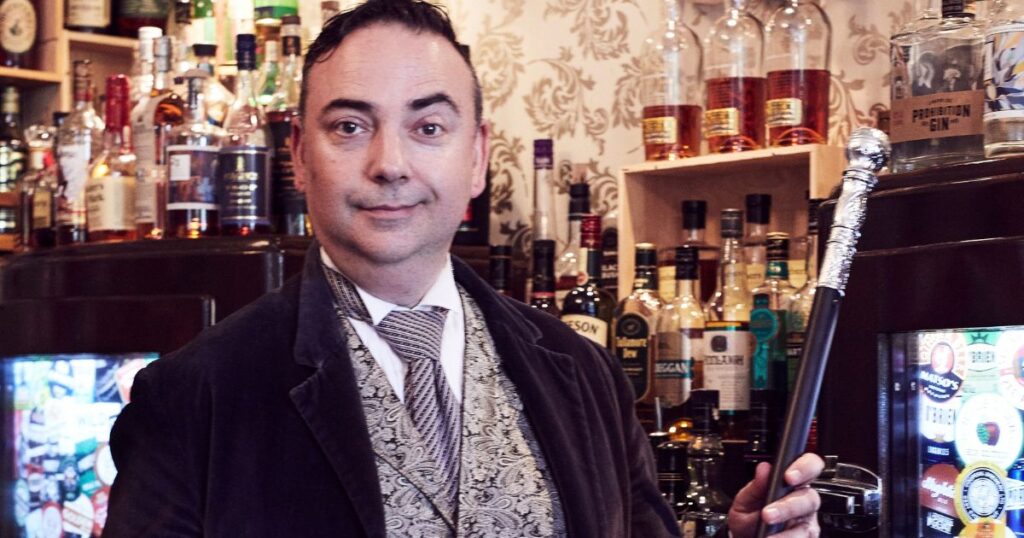
This post was written to mark Oscar Wilde’s 172nd birthday on October 16, 2026. And the photo of Steve Davis was taken by Brent Leideritz.