
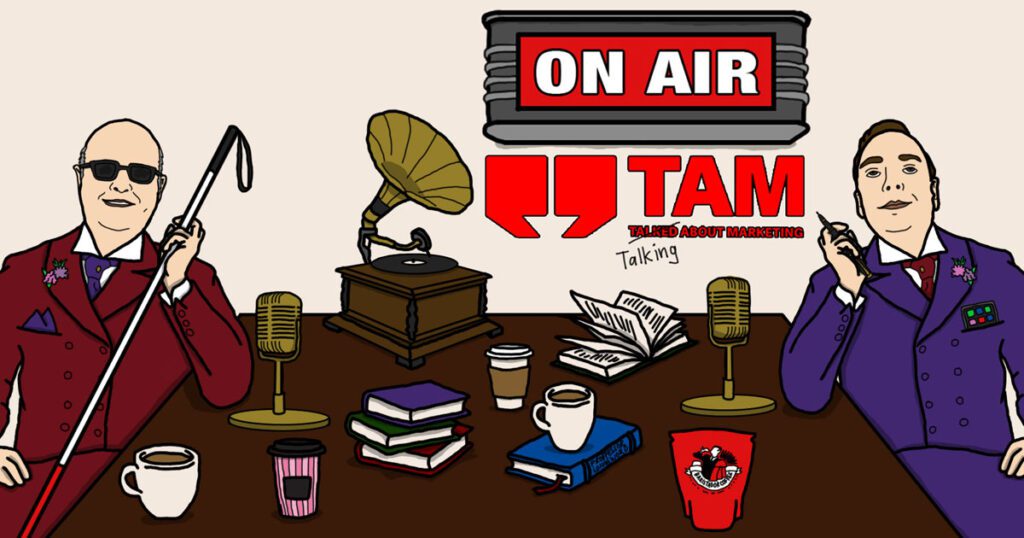
From a thank you at a pedestrian crossing to a dessert upsell at the McDonald’s counter, we find that people copy what others value, so it pays to say it out loud when someone makes an effort.
David’s breakfast walk to Mylk Bar turned into the most talked-about blog post he has written, and Steve has a theory about why it hit small business owners so hard: our effort runs 24 hours a day and rarely earns a “thanks for doing that.”
Robert Cialdini explains why a McDonald’s counter worker saying “the McFlurry is our most popular” lifted dessert sales by 45%. Our hosts ask what that means for a pizza shop with two stores and two very different favourites.
Meta wants a monthly fee to help you after you’ve been hacked, and that’s before it limits how many links your business page can share. Steve and David suggest a megaphone is a fine tool and a terrible home.
Finally, the 1949 Camel campaign shows social proof working for the wrong team, and David reckons it would still work today if the ban were lifted.
Get ready to take notes.
Talking About Marketing podcast episode notes with timecodes
01:45 Person This segment focusses on you, the person, because we believe business is personal.
A Cane, a Dog Water Bowl and a Thank You at the Crossing
Steve opens by thanking David for making an effort, because one of David’s recent blog posts drew a much bigger reaction than usual. It starts on a walk to breakfast at Mylk Bar. David steers around the furniture at Cibo Espresso, taps the dog water bowl with his cane without spilling it (“always a win”), listens to both traffic signals and lines up at the ramp. An elderly gentleman behind him says he doesn’t know how David does it. David says it’s worth the effort. The gentleman says his legs and hearing aren’t what they were, and he still can’t work it out. David’s reply: “Same as you. I keep making an effort.” Then the lights change, and David hears how hard each of the man’s steps is.
David’s takeaway is that it’s lovely to have your effort recognised and just as lovely to recognise someone else’s, with no expectation of anything more. Steve then brings it home to small business. Anyone who owns or carries responsibility in a small business puts in effort around the clock, and most of it goes unnoticed. Steve wonders how thirsty our fields must be for a little rain of acknowledgement, and David adds that it takes only a “wow, thanks for doing that.” Nobody is asking for perfection. Steve shares his own habit of thanking ambulance officers, the café that reopened during COVID, and the chiropractor who fixed his arm after a long drive to Port Lincoln.
So what if nobody thanks you? David says you can still pause and notice that you did a task well rather than doing the bare minimum, even if it’s only rinsing the soap off the dishes. You will be the one picking up that glass tomorrow.
09:15 Principles This segment focusses principles you can apply in your business today.
“The McFlurry Is Our Most Popular” and Why That Works
Steve builds up to Robert Cialdini with a very personal question about McDonald’s. David confesses to a weakness for thick shakes and a long search for one as good as his 10-year-old memory. Then to the research. In Cialdini’s telling, captured on the Every Thing They Don’t Tell You Podcast, half the customers at a McDonald’s counter were asked if they wanted a dessert. The other half heard the same question followed by “the McFlurry is our most popular.” Dessert sales rose 45%, and almost all of them were McFlurries. That’s social proof: evidence that plenty of people like you have already chosen.
The hosts connect it to the Paradox of Choice. When there are too many options we often pick nothing, so naming the popular choice turns a big decision into a small one. David sees it in his legal marketing work in America, where linking a campaign to what a significant group of attorneys have already done always goes well. Both admit they forget to do this for themselves, like the chef who goes home and eats baked beans on toast. Steve is thinking about his client Raza, whose two Pedro’s Pizza stores have different bestsellers: meat lovers in Craigmore, chicken and avocado in Somerton Park. A staff member saying “this is the one most people choose here” could make the decision easier for a customer standing at the counter.
The rule is to shine a light on where others have gathered, and to keep it true. David points out that someone will always say “prove it,” so you’d better be able to.
18:15 Problems This segment answers questions we've received from clients or listeners.
Meta One and the Two-Link Toll Booth
Steve and David turn to a company they’ve little affection for. Some Facebook business pages, The Adelaide Show among them, are now limited to two posts a month containing an external link. A listener, Belle Baker, shared a post from Liz Nable (I think we were saying Liz Noble in the recording, sorry Liz) in Sydney about Meta One, a paid subscription launched in Australia. Liz’s rundown of the tiers, drawn from a Smart Company article, runs from about $23 a month for a verification badge and more AI support, to $77 for a live call with a human, up to $769 for a dedicated case manager. Meta One only works for accounts already active and in good standing, so the businesses locked out and needing help most can’t buy their way back in.
Steve shares a workaround for the link limit: post the link in a comment from your personal account rather than the business page. He also suggests borrowing from Instagram, where “link in bio” points to a landing page you control. David wonders how this escapes the ACCC’s attention, and Steve suspects the relationships between big tech and government make it murky. The advice they have given since the year dot is to own your own home: a website on a domain name you control, with social media as the megaphone. Steve also reads a passage from his Oscar Wilde birthday blog post (Oscar would be 172), in which Oscar has some choice words for Meta’s gatekeeping.
30:15 Perspicacity This segment is designed to sharpen our thinking by reflecting on a case study from the past.
More Doctors Smoke Camels, or Social Proof Goes Evil
In 1949, Camel ran a TV ad built on a doctors’ survey: more doctors smoke Camels than any other cigarette. Steve notes the ad invites you to try them for 30 days like a new medicine. David points out that today the social proof sits on the other side of the equation, and we look back at that ad as a bizarre moment in history.
The hosts then unpack why it may have worked. David explains that many doctors of that generation had come through the Depression and the war, and smoking was a normal way to cope with stress. Steve adds that it also worked as an appetite suppressant, an early Ozempic. Would the ad work today? It would be banned, so the question needs a hypothetical. Steve wonders whether a ban-free world would also attract the person who does something to spite the establishment. David says teenage vaping shows social proof has immense power, even when the group is small and breaking the law. Steve links it to Angela Duckworth’s book Situated from the last episode: the people around us shape what we do.
David’s verdict is that social proof works at such a deep psychological level that it would have a chance even for a dangerous product. His reminder for small business owners is to never discount its power over you, and never discount its value to you.
Transcript This transcript was generated using Descript.
A Machine-Generated Transcript – Beware Errors
S09E06
Caitlin Davis: [00:00:00] Thinking about Marketing is a podcast for business owners and leaders, produced by Steve Davis and David Oldney of Talked About Marketing. More than 8,000 conversations have taught them something. You can’t read the label from inside the bottle. Everyone needs external perspective. Through their four Ps, person, principles, problems, and perspicacity, yes, you heard that correctly, they explore marketing with curiosity, generosity, and the occasional gentle eye roll.
They hope this becomes a trusted companion on your journey in business[00:01:00]
Steve Davis: David, does, uh, do you feel best doing something no one else does, or do you like mimicking or getting inspiration from others?
David Olney: I like inspiration from others. Inspiration from others is nice.
Steve Davis: Does that mean you’re plagiarizing your way through life?
David Olney: I hope so. It’s easier than working it out.
Steve Davis: Robert Cialdini will be so impressed
Caitlin Davis: Our four Ps. Number one, person. These are insights for the whole person, not just the business operator. Oscar Wilde put it this way: “The aim of life is self-development, to realize one’s nature perfectly. That’s what each of us is here for.”
Steve Davis: In the person segment, [00:02:00] I’d like us to start by thanking you, David, for making an effort.
David Olney: Thank you very much for making an effort about me making an effort.
Steve Davis: The reason we’re talking like this is because David does blog actively, and, you know, they go out there and the cerebral people react and respond, and it’s lovely. But there was one post in particular, which we’ve now added to the website as well, that went off the charts in people’s reaction.
Can you tell us what was the post about David, and, uh, so the gist of it, and then what surprised you in the feedback?
David Olney: The post was all about the fact that last week I was walking to Milk Bar to have breakfast, and I was doing my normal thing of navigating carefully around all the furniture at Cibo’s, and I managed to dong the dog water bowl as usual with my cane without spilling the water, so that’s always a win when the water doesn’t go everywhere.
And then I’d listen to which way the two traffic lights were [00:03:00] going, and I’d line myself up at the ramp, and then I heard this lovely elderly gentleman’s voice behind me going, “Gosh, I don’t know how you do it. That’s remarkable.” He’d obviously seen what I’d done, and I just said, you know, “Thank you. It’s worth the effort.
You know, it makes life a lot easier when I, I get it right.” And then the elderly gentleman made the point, “Well, you know, my legs don’t work so well, and I don’t hear so well, but I, I, I still don’t know how you do that.” And I said, “Well, same as you. I keep making an effort.” And then the light changed, and we said goodbye to each other, and then I got to hear how hard it was for him to walk.
Steve Davis: Oh, you actually heard the effort?
David Olney: Yes. Like, he was literally having to wrench each foot forward and up and then land it with a scuff. And, you know, for him trying to get across Archer Street in the amount of time of the lights was probably the limit of how fast he could go.
Steve Davis: So you shared this in a post.
David Olney: I did.
Steve Davis: And what was the ultimate [00:04:00] point you were making?
David Olney: The ultimate point I was making is it was such a nice interaction that I wanted to write about it anyway, but I couldn’t help but feel there was something more, that it was such a nice interaction, that this guy is so amazed with my effort when once I could hear what he’d…
was doing, I was so amazed by his. But when I thought about it for the day before I wrote the blog, what I realized was it’s so nice to have your effort recognized
Steve Davis: Hmm
David Olney: And it’s so nice to recognize someone else’s effort. And in real terms, you know, because he’d said to me, “Oh, my legs don’t work so well, and I don’t hear so well,” I could say, “Yeah, but I’m doing the same thing as you.
I’m making an effort.” I was able to sort of reciprocate the kindness of acknowledging that he’s putting this work in to just be in the world and engage and participate, when it would probably be a lot easier not to. And we both did that for each other without any, [00:05:00] any expectation that there’s anything more than just it’s nice to connect with people while you’re out there in the world doing what you need to do.
But he was probably putting in an even bigger effort to navigate that morning than I was.
Steve Davis: And what I find interesting in this is anyone who’s a small business owner or someone working, uh, with responsibility within a small business, the effort that is required of us to put in almost 24 hours a day does largely go unnoticed and unrecognized.
Yeah,
David Olney: unacknowledged.
Steve Davis: How thirsty our fields must be for a little bit of rain of acknowledgement every now and then. Yeah.
David Olney: Just a, “Wow, thanks for doing that.”
Steve Davis: Hmm.
David Olney: Yeah, it’s not that we’re asking people to be perfect. You know, acknowledging my effort that morning wasn’t gonna change how well I navigate or anything more about that, that elderly gentleman’s day other [00:06:00] than it was nice to interact for a sec.
And I hope he walked away going, “Gosh, I put in effort too.” I really hope that that’s the thought he had as he went on with his day, and someone appreciated it.
Steve Davis: I just realized, so our family, if we ever bump into a ambulance officer wherever we are, we, I, I particularly, but my girls also do, make an effort of saying, “Hey, thanks for doing what you’re doing.”
David Olney: Yep.
Steve Davis: Um, in the throes of COVID, as we were starting to try and rebuild, I had a city office still, and the local cafe had opened up again. I remember on a few occasions just saying, “Hey, thank you. Thank you for opening up,” ’cause it just enriches my experience.
David Olney: Yeah.
Steve Davis: And, uh, oh, when I had, um, I really, I drove back and f- to and from, um, Port Lincoln and stupidly left my, uh, right arm up on the window ledge, came back with [00:07:00] the worst muscle pain.
Ooh. And my chiropractor fixed it. I remember saying, “Look, hey, thank you for being here. Thank you for doing what you do.” Is that what you’re talking about?
David Olney: Yes. Just acknowledging people for the fact that you don’t know what the rest of the day, their day was like, but they’ve just done something that makes the world a better place Even if it just makes you smile for a minute or makes you go, actually, you think you’re just going through the world unnoticed, putting in the work to navigate, in my case, to navigate with a cane.
This elderly gentleman’s case, he’s working hard just to walk. It’s not like we won a prize for it, but it’s really nice to be acknowledged for doing something difficult and doing something better than average.
Steve Davis: On that note then, for the person segment, I guess our takeaway is to be mindful of those around us and saying a thank you for stuff they do that meets those criteria.
What if there’s no one [00:08:00] around to thank us, though? Um, this– Well, it’s, it’s not the same if we thank ourselves,
David Olney: is it? No, it’s not. But then it’s also good to acknowledge, hey, I could have done that task two ways. I could have done the bare minimum, and tomorrow I would have had to do more because today I did the bare minimum.
But I actually did a good version of it today. Like to me, even something as simple as going and doing the dishes. Do you rinse all the soap off or do you leave it on there to turn into that weird kind of film of soap bubbles? It’s a tiny thing, but how would you rather pick up and use a glass or a piece of cutlery tomorrow?
Steve Davis: Yeah, okay. So that is just that pause to look back on what we’ve done for that sense of satisfaction.
David Olney: Yeah. That I did that reasonably well, and even if someone else doesn’t appreciate it now, I’m gonna benefit for doing it that little bit better than it could have been done.
Steve Davis: Thanks for making the effort of sharing that story.
David Olney: Thank you.[00:09:00]
Caitlin Davis: Our four Ps. Number two, principles. These are ideas worth building on. As Oscar Wilde reminded us, you can never be overdressed or over-educated.
Steve Davis: In the principle segment, I need to ask you a very personal question, David. It might take you outside your comfort zone.
David Olney: Okay.
Steve Davis: Do you ever eat McDonald’s?
David Olney: I am known periodically to crave a thick shake.
Steve Davis: Okay.
David Olney: And I am convinced they are not as good as they were when I was 10, ’cause then they probably had trans fats, and probably had all sorts of stuff that was really terrible, and now they’re just cheap and nasty. But I have been known to try them from all sort of mainstream vendors, including McDonald’s, to find a thick shake that is as good as my 10-year-old [00:10:00] memory of a thick shake.
Steve Davis: Wow. That is a deeper answer than I was expecting.
David Olney: It’s a deep question.
Steve Davis: Um, would you like fri- actually, not would you like fries with that, would you have dessert with that? Would you grab a, an apple pie or a McFlurry to go with your thick shake?
David Olney: I could be tempted to getting fries with it, but if I’m already having essentially the liquid dessert, you know, they’d, they’d have to be sophisticated on their script.
Steve Davis: Uh, so dear listener, you’re probably wondering what the heck I’m going on and on about here. It’s because Robert Cialdini, who we like, he is the father of persuasion. Well, he certainly popularized the understanding of, uh, the psychology of persuasion.
David Olney: Yeah, he’s the father of academic research into persuasion.
Most good ad people had worked it all out anecdotally, but he proved why these things work.
Steve Davis: And I think we’ve talked about him before. Mm. Uh, it’s a seminal book. I think I, I actually had it for my own general reading before I even moved into marketing. I just-
David Olney: Mm …
Steve Davis: loved it. Anyway, uh, the, we’ve got a little snippet of [00:11:00] him talking here about social proof, which is one of the things that’s an important principle in our day-to-day marketing.
Let’s have a listen.
Robert Cialdini: A problem that McDonald’s has, which is essentially getting people to purchase more than what they typically buy. That’s dessert. Study was done for half of the people who came in for one week, the person behind the counter at the end of the order said, “Would you like to purchase a dessert?” That’s the control group.
That’s what they normally would say. The other half of the people heard, “Would you like to purchase a dessert? The McFlurry is our most popular here.” In other words, social proof, and they got a 45% increase in the purchase of desserts. Almost all were McFlurries. If you can give people evidence of a lot of others just like them who have decided for your products or services, they will say, “Well, if a lot of people [00:12:00] just like me have done it, I don’t have to think through all of the pros and cons.
That’s a good rule of thumb to know that if I move in that direction, I’ll be right, too.” You haven’t deceived anybody. You’ve given them valuable information that allows them to make a good choice for themselves.
Steve Davis: Okay, David. Th- would you, if you were in that, let’s say you weren’t going in for a thick shake, because that’s, that’s a bit weird. You’re going in for a burger. I know I’m weird. Yeah. Let’s say, let’s pretend, first of all, that you’re not weird. Mm. Okay? Uh, you’re getting a burger. Would you be tempted to have a dessert if you were told that, “This is our most popular”?
David Olney: See, historically, 10-year-old me loved having a chocolate sundae. And I wouldn’t- Oh … have had the McFlurry because the chocolate sundae was actually so damn good. But I would’ve had a dessert. So I’m one of those people that y- you know, you could ask [00:13:00] me, and I’d go, “Oh, yeah, I want a chocolate sundae.” You wouldn’t have to say the other half of the line.
But social proof is one of the most powerful- Yeah … ideas anyone has ever researched and confirmed.
Steve Davis: And first of all, um, David, why did you mention that? ‘Cause now I’m remembering my- Yeah … my 20-year-old me is remembering that. Because that warmed up chocolate fudge- Yes … on that beautiful
David Olney: Soft serve that was probably really, really bad.
Uh- But really tasted good. The combination- Okay … of the gooey chocolate- Yeah, yeah … and the soft serve.
Steve Davis: Focus. Wait, wait, wait, wait. Um-
David Olney: No, it’s yum. Wait. I wanna think about the yum.
Steve Davis: Um, th- social proof, then. Let’s not lose, let’s not lose that, because I think I understand why it works. It, it also is drawn from Robert Cialdini’s work, ’cause he talks about…
Actually, also, I think it’s, is it Barry White, The Paradox of Choice? Um, uh, uh, there’s a lot of research in this field. Yeah. When we have to make a choice and there are [00:14:00] too many options, we often choose nothing.
David Olney: Yep.
Steve Davis: Or we
David Olney: just- Analysis paralysis …
Steve Davis: revert back to the normal thing we would get, which might be nothing or it might be something.
David Olney: Mm.
Steve Davis: Here, when they plant the seed of an idea of a dessert, but then say, the McFlurry is the most popular.
David Olney: Mm.
Steve Davis: I can understand how the brain goes, “Oh, well, it’s either a question of do I want dessert or not? Because if I do, I know what I’m gonna have.” Mm. This is where everyone has shown that it’s a safe, delicious, one assumes, choice, so I’ll go that way.
It just makes it easier.
David Olney: Yep. Yeah, and, and this is something pretty frivolous, you know, dessert at McDonald’s. Yeah. But in the legal marketing work I do in America, any campaign we do where we can link what a significant group of attorneys have done in terms of marketing or professional services, and show how we fit the best practice from that social [00:15:00] proof, that campaign always goes really well
Steve Davis: And I’m actually thinking now, there probably are a couple of things in our suite of options where, while still being bound by being, uh, truthful, I could actually say, “These are the options, but this is actually the one most people choose.”
This is
David Olney: what most people pick, and this is what they get out of it. Yeah. And this is the great thing of us being reminded when we record the episodes- Yes … of things that we use with clients in the moment- Yes … because it’s so much part of how we work. But then when we’re just sitting here, we go, “Oh.” Hmm. “Do we do it for ourselves?”
It’s like the chef who goes home and eats baked beans on toast.
Steve Davis: Yes.
David Olney: We so busy doing things during the day for and with clients, that we forget to do them for ourselves.
Steve Davis: So really, a simple principles method, uh, or message for this segment, and it’s just this. If you are, um, leading customers through a choice matrix, [00:16:00] helping them make some decisions, help them make the decisions more easily by shining a light on where others have congregated.
If that’s the case, I would be very uncomfortable about lying or tricking this up though, David.
David Olney: No, because, again, what works is it’s true. Like McDonald’s can say it ’cause it’s true. They have the data, and even if the kid saying it doesn’t know that, if someone wants to look, it, it’s true. And, you know, social proof, the thing with it, you will always get someone who’ll go, “Prove it.”
So you better be able to. We certainly do in legal marketing, get people who go, “Prove it.”
Steve Davis: And I’m pretty sure, I, I’m pretty sure Raza won’t mind me mentioning this, but we’re working with Raza from Pedro’s Pizza at the moment, and it came up today that he’s got two stores. There’s one in Craigmoore and one in Somerton Park, and he was talking about, uh, what the, the popular ones are at each end.
And at Craigmoore, it’s very much the meat lovers [00:17:00] dominates, uh, the buying habits there, and at Somerton Park, it’s the chicken and avocado pizza. And so, uh, one thing I think I’ll be mentioning to him at some point is that that’s a useful thing for his people at either end just to note. If someone is, as I was when I went to the Somerton Park store, standing there going, “Hmm, I’m not sure”-
David Olney: Yeah
Steve Davis: for them to be able to say, “Look, the, the one that’s most popular in our store is our chicken and avocado,” I think it just makes my decision-making process that much easier.
David Olney: It really does. It’s nice to hear from the person who’s gonna make it, “I like this one,” or-
Steve Davis: Yes … “
David Olney: This is the one people come back and order the second time they come in.”
You know? Yeah. They come back and get it again.
Steve Davis: See, now I feel like pizza followed by a sundae.
David Olney: Yeah, but the problem is I now want the meat lovers- … the chicken and avocado, and then the sundae. It’s gonna be a really painful stomach day.
Steve Davis: We might have a bit of a break before we come back with the problem segment.
I, I think part of the problem’s going to be indigestion.[00:18:00]
Caitlin Davis: Our four Ps. Number three, problems. These are the marketing challenges keeping you up at night. As Oscar said, “We ask questions for the best reason possible. Simple curiosity, no hidden agenda, just genuine interest in what’s actually happening.”
Steve Davis: Let’s turn to problems now. And we have a problem to discuss, David, and how do you solve a problem like Meta?
David Olney: Uh, with a bucket, water- Yes … and concrete.
Steve Davis: I tell you what, I so hate this company. It is a detestable, uh, fable of dystopian excess. Tapping into a basic human inclination, unlocking great potential among people, getting people excited, getting people habituated, [00:19:00] and then shutting the gates, turning the screws, and we are staying here.
We’re not… Few of us are trying to escape. That is Meta, that is Facebook, that is Instagram. Am I too bleak?
David Olney: No. Look, for all the potential it had, the capacity to pervert it into, how do we get rich by treating our customers poorly, is quite remarkable.
Steve Davis: So the latest thing they’ve done, um, it’s funny, we, we were planning to talk about this anyway, but, um, one of our dear listeners, Belle Baker, who thinks we’re funny, David.
She thinks we’re funny.
David Olney: We have our moments.
Steve Davis: Mm. Um, she shared a post, uh, by someone on social media who was talking about this push from Meta to get businesses to take up a Meta One subscription. Uh, we, uh, for, for business reasons, I’ll let her explain that in just a moment. However, the reason I wanted to, to talk about it is they’ve been experimenting, but with different accounts.[00:20:00]
Let’s say you’ve got a business page on Facebook. Um, the Adelaide Show has just had this put on them, but not every page yet, and that is this limit of only two posts per month can have an external link. So if you’re gonna do a link to your post, uh, to your blog post, and share it on Facebook, you get two bites of that cherry, and then you’ve got to be on a paid plan just for that.
The simple act, David, that the whole internet is built on, which is the sharing of links, uh, as Tim Berners-Lee said, “Information wants to be free,” and they’re just blocking that.
David Olney: But Meta wants to corral.
Steve Davis: Yeah. I think Meta should go into the, um, the butchery business. I could just see them running meat works really well.
Um, anyway, so that is a real thing that’s happening increasingly across pages. Um, I found one little workaround on [00:21:00] that, by the way, and that is even if you, as you see some people say, “Hey, link in the comments,” you go and do that, but you’re still your business page, that’s also banned. But I come back as me, as the human, and I put the link in in the comment as me, the personal account.
That’s a pretty rough and ready workaround. So The Adelaide Show has a post up, go and listen, and then the very first comment is from me, Steve Davis, not The Adelaide Show, saying, “Here’s the link to the episode.” That’s one workaround. And the other option is to learn from Instagram, ’cause in Instagram, of course, we can’t have links in our, our captions unless you’re at a super towering level.
Um, we always say the link is in the bio, and the question is, do you have the link in your bio go to a, a, a custom-made landing page so that when someone goes there, they can readily get access to the thing that you were talking about? [00:22:00] Doing that on Facebook, I think, is going to be the new discipline, is making sure you’ve got a dynamic landing page you can send people to.
Uh, it won’t necessarily have post by post, but it’ll have a link to your posts. You’ll have a link to a few other things that are helpful, uh, as a way to get around this, um, as a workaround. But let’s have a listen now to the other thing that this is impacted by, uh, Liz Knable from Sydney. This is the, um, the piece that Bill shared with us commenting on an article in Smart Company.
Liz Nable: Guys, I don’t think I could make this stuff up if I tried. It just gets better and better. So this just dropped from Smart Company. Meta has launched something called Meta One here in Australia today. Does any of this sound familiar? For years, small businesses have been getting locked out of their Facebook and Instagram accounts with zero warning, spammed, hacked, and banned from ads for seemingly no good reason at all, and no way to reach [00:23:00] an actual person.
It’s gotten so bad that just this week the media has reported that businesses have been flooding the small business ombudsman’s personal email inbox just trying to get help. Meta’s solution? “Sure, we’ll help you, but you’re gonna have to pay for it.” Here’s the breakdown. Entry level is about $23 a month, so you get a verification badge, don’t know what that’s for, and more AI support.
The advanced plan is $77 a month. That’s the one where you actually get a live phone call with a real human if the AI bot can’t fix your problem. Then it goes up to $229 a month and even $769 a month for a dedicated case manager. But here’s the catch nobody’s talking about. If your account is already suspended, this doesn’t help you.
Meta One only works for accounts that are already active and in good standing, so the businesses who still need help the most can’t buy their way to a fix. Can you imagine if a small business did this? “Oh, you want to return your faulty product? Pay a monthly subscription and [00:24:00] we’ll give you our direct line.
Actually, it’s not even a direct line, it’s an AI agent.” “Oh, you need help with something that doesn’t work with our system? Pay us a fee and we might email you back.” Or, “We accidentally overcharged you and you want a refund? Sorry, you’re not on our customer service payment plan. We can’t help you.” Any small business that ran their support like that would be out of business within a week.
Meta just made it a pricing tier. Meta says this isn’t pay to win, it’s a strategic offering. Sure. This is exactly why I tell every founder I coach, “Build the stuff you actually own, your email list, your podcast, your website.” Social media should be your megaphone, never your only home, and definitely never your only customer service line.
Would you pay for this? Maybe you have no choice. Tell me in the comments.
Steve Davis: Just the gall of this, David. The gall that you have a system [00:25:00] that hackers can game to lock good people out of their account And you take no responsibility for the sieve-like interface with all those holes in it, and your only solution is that it’s a bluffing game. Before you have been compromised, you have to take out insurance and start paying a fee per month so that if one day you are compromised, they can help you.
David Olney: I’m assuming Mark Zuckerberg just watched The Godfather.
Steve Davis: Absolutely. This is mafioso all over. I’m, uh, I am speechless. I thought we’ve seen the lowest this company can stretch to. And, and I think Liz makes a good point, um, in her post. She said, “Imagine a small business saying this, ‘I, I’ve come in to return something.’
‘Well, [00:26:00] sadly, you didn’t have our customer subscription, um, which you need before that, and so you’re not eligible to return. Sorry.’ Or, or if you go to buy something, ‘Oh, by the way, you’ve gotta pay 70 bucks a month, uh, for the rest of your life. Uh, on, on the occasion you might wanna return it, uh, then we will talk to you or maybe have our robot talk to you.'”
David Olney: No.
Camel Ad: Absolutely
Steve Davis: gusts my head in.
David Olney: I, I can’t believe that this doesn’t fit under the category of monopolistic behavior, because only they could do something that no other company could survive, because there isn’t an alternative platform. So y- you would think this is something that the ACCC could smash them about the head over.
Um, I would hope.
Steve Davis: I would feel that, Al. Uh, somehow these big tech bros and the government, they have relationships. They have so much interbalanced vested interest. It gets murky, David.
David Olney: Yeah, and I suppose the fact that we’ve already done the ban for under 16 year olds using Facebook in [00:27:00] Australia means we’re probably not gonna push hard on anything else.
Steve Davis: Hmm. So, um, I’m just making sure that you’re aware of this so that… Well, I guess the other point is, which is what Liz makes, but this is what we’ve made since The Year Dot, is never ever, ever, ever, ever let your business have all its eggs in the Meta basket. It’s gotta be on your own website with a domain name that you have direct connection to, not some agency, you.
Um, and then you use social channels to amplify your messaging and connect with people while you can. Uh, but if we put our eggs in that basket, who would trust Mark Zuckerberg with your nest egg? I wouldn’t.
David Olney: As Liz said, you know, Facebook’s a megaphone, and we need to essentially use the megaphone to point out how awful they are.
Steve Davis: Yes, which we are at the moment. Uh, and not only us, David, but do you [00:28:00] believe Oscar Wilde had some words to say about this new move by Facebook?
David Olney: Was he wearing a floppy hat at the time?
Steve Davis: Of course, always. He wouldn’t be seen dead without one. Uh, it’s Oscar Wilde’s birthday, uh, later in the week this comes out.
He’d be 172, and doesn’t look a day over 30, does he?
David Olney: Well, it depends on the quality of the whiskey he’s currently drinking.
Steve Davis: Anyway, um, I’ve done a blog post in the voice and style of Oscar, um, to mark his birthday, and he does comment on this. And, uh, I’ll put the link in the show notes, but here’s the passage that relates to it.
I think this is exactly how Oscar would describe it. He says, “It’s a curious transaction. We permit ourselves to be turned into mere figures of entertainment, slowly reduced to the condition of suckling lemmings, blindly tethered to the silicone teat of some earnest young mechanic from California. For more than a decade, this pious digital warder lulled [00:29:00] commerce into sweet contentment, clutching our unsuspecting enterprises to his bosom with all the suffocating affection of a spider entertaining flies.
Having persuaded every shopkeeper into his salon, the turnkey now casually locks the gate. He rations each unfortunate merchant to a stingy allowance of two outbound doorways a month, demanding a monthly ransom if one dares allow a customer to escape their blue-tinted lair into our own. To demand a toll simply for letting a guest step out into the street is the sort of commercial audacity that would make a pawnbroker blush with professional envy.
He does not nourish us. He merely trains us to crave the very toxic sludge we helped him distill from our own vanity while charging us for a glimpse of the open air.” Happy birthday, Oscar.[00:30:00]
Caitlin Davis: Our four Ps. Number four, perspicacity. Let’s examine a campaign from the past and ask, would it work today? As Oscar Wilde believed, our one duty to history is to rewrite it. So let’s see what we can learn.
Steve Davis: David, in perspicacity, just when you think it couldn’t get any worse.
David Olney: Social proof goes evil.
Steve Davis: Do you know what?
I think if Mark Zuckerberg had of been born in the 1920s, he would’ve run a tobacco company, because in 1949, Camel cigarettes had this TV ad playing, which was not their first. It was part of a follow-up campaign. The ad makes that clear. Let’s have a listen to the classic More Doctors Smoke [00:31:00] Camels than any other cigarette.
Camel Ad: You know, if you were to follow a busy doctor as he makes his daily round of calls, you’d find yourself having a mighty busy time keeping up with him. Time out for many men of medicine usually means just long enough to enjoy a cigarette. And because they know what a pleasure it is to smoke a mild, good-tasting cigarette, they’re particular about the brand they choose.
In a repeated national survey, doctors in all branches of medicine, doctors in all parts of the country were asked, “What cigarette do you smoke, Doctor?” Once again, the brand named most was Camel. Yes, according to this repeated nationwide survey, more doctors smoke Camels than any other cigarette. Why not change to Camels for the next thirty days and see what a difference it makes in your smoking enjoyment?
See how Camels agree with your throat. [00:32:00] See how mild and good-tasting a cigarette can be.
Steve Davis: Well, David, you’ve already established that if others are having a certain dessert, you’d have one. Does this now mean you’re gonna take up smoking?
David Olney: Thankfully, in 2026, an ad like that is just, wow, there’s the power of social proof.
But thankfully today, the social proof is on the other side of the equation, where we go, “What a bizarre world it must have been, where you could use social proof to make people sick.”
Steve Davis: I know. And the audacity of it. You know, try it for 30 days, like it’s a new drug.
David Olney: Yeah.
Steve Davis: Like a medicine.
David Olney: Your, your throat will feel so happy.
It’s like, well, how is your throat feel? Well, shouldn’t you think about smoking if your throat doesn’t feel good?
Steve Davis: Probably why doctors don’t fill in surveys very much these days. One wonders if their words were twisted.
David Olney: Actually, th- [00:33:00] that’s, that’s such an interesting thought. Like, how many doctors would’ve smoked?
Probably a heap. ‘
Steve Davis: Cause that was, again, social proof. It was a normal-
David Olney: A normal thing …
Steve Davis: or it, it seems to be, have been a normal thing.
David Olney: And a generation of doctors in the US who had all been through World War II and were maybe on the GI Bill, had gone through immense stress in the Depression and the war.
Smoking was a normal way to cope with stress. You’re looking at a society that you gotta do something with your hands and your stress. Smoking was at horrendously high levels.
Steve Davis: And did it also … I mean, during a time of, uh, ups and downs of feast and famine, I wonder if smoking, ’cause it’s, I believe it’s an appetite- Appetite
David Olney: suppressant
Steve Davis: suppressant.
David Olney: So yeah.
Steve Davis: It’s like an early Ozempic.
David Olney: Yeah.
Steve Davis: Um, so that was part and parcel of just life, which is why, I’m, I’m having a few coins drop for me. It’s why we see, is one of the reasons why we see less of … Like, in this day and age, everyone’s planning what they’re gonna eat in the next few hours, and blah, blah, blah.
Back then, they [00:34:00] didn’t seem to be as beholden to that. No. Uh, but also the food they were eating was probably more wholesome and, and satiating as well. Yeah, food
David Olney: was food.
Steve Davis: Food
David Olney: was food. And the cigarette meant you didn’t want as much food. It’s a kind of a double win.
Steve Davis: So it’s a really fascinating thing to tease apart.
However, we are not going to be apologists for, uh, tobacco because we now know it is just a bad medicine. Mm. It’s not a b- it’s terrible. Um, would this ad work today? Well, A, it actually would be prescrib- proscribed. It wouldn’t- Yeah … be allowed to be shown. If it, let’s say that rule wasn’t there, I think you’ve nailed it, David.
I think, um … Well, actually, there’s two parts to this. Yes, social proof, the social momentum is on the side of those of us who don’t smoke. Smoking numbers-
David Olney: Yep …
Steve Davis: are dropping down. Uh, vaping’s around there somewhere. However, this worries me. There is a [00:35:00] very much knee-jerk, I’ll do it to spite the establishment mentality, that I wonder if such ads were allowed, there’d be a certain person, the person who casts a protest vote for a politician who is nothing other than a bundle of anger and hatred, would be the same person who would take up smoking just to prove that they can’t be stopped.
Do you think that there’s a risk that this could actually have toxic repercussions we might not c- uh, consider? It’s a form of social proof from a subgroup
David Olney: Again, this is about what the group you wanna be a part of does.
Steve Davis: Mm.
David Olney: So when you were talking about vaping, my first thought then was, well, really, vaping continues to grow despite being, you know, well, it’s supposed to be difficult to get a vape, [00:36:00] you know, if you’re a kid, but look how many teenagers smoke.
Well, look how many teenagers vape. So social proof, even in a small group breaking the law, it still has immense power. Mm. So don’t ever discount the power of social proof over you, and don’t ever discount the value of social proof to you if you’re trying to get the world to pay attention to your product or service.
Steve Davis: And we know from our last episode talking about Angela Duckworth and her book, Situated, it’s the people in whose culture we are sitting-
David Olney: Yeah …
Steve Davis: the people around us, that govern largely what we do. So social proof is part of that.
David Olney: Yep. It’s the reason, even though I don’t teach strategic culture formally anymore, I still make sense of the world through what does the group of people central to this believe?
What is their behavior? How are they selecting members of the group? How are they maintaining discipline and behavior in the group? Because that’s still how the world works.
Steve Davis: So the question we ask in Perspicacity to finish off with, would [00:37:00] this ad work today? So for this to be answered any way other than not, not applicable, we have to take off the ban.
So let’s imagine it’s not banned. Would the ad work today, Damon?
David Olney: I think if there wasn’t a ban, anything that says social proof, strangely- Mm … is working at such a deep psychological level that it always has a chance of working, even if the product itself is dangerous.
Steve Davis: All right. But I think what we’ll do, as far as this conversation is concerned, is, um, butt out right now.
David Olney: Or smoke ’em if you got ’em.
Steve Davis: No, he didn’t say that. He didn’t say that.
Caitlin Davis: Thanks for listening to Talking About Marketing. If you found this helpful, please share it with someone who might benefit. And if you’re so inclined, leave a rating in your podcast app. Both [00:38:00] help more than you think. Steve and David welcome your thoughts, which you can send to podcast@talkedaboutmarketing.com.
That’s podcast@talkedaboutmarketing.com. Want to continue the conversation beyond the podcast? You can book 20 minutes with Steve at talkedaboutmarketing.com. No cost, no obligation. And we’ll leave the last word to Oscar Wilde, “There’s only one thing worse than being talked about, and that’s not being talked about.”