
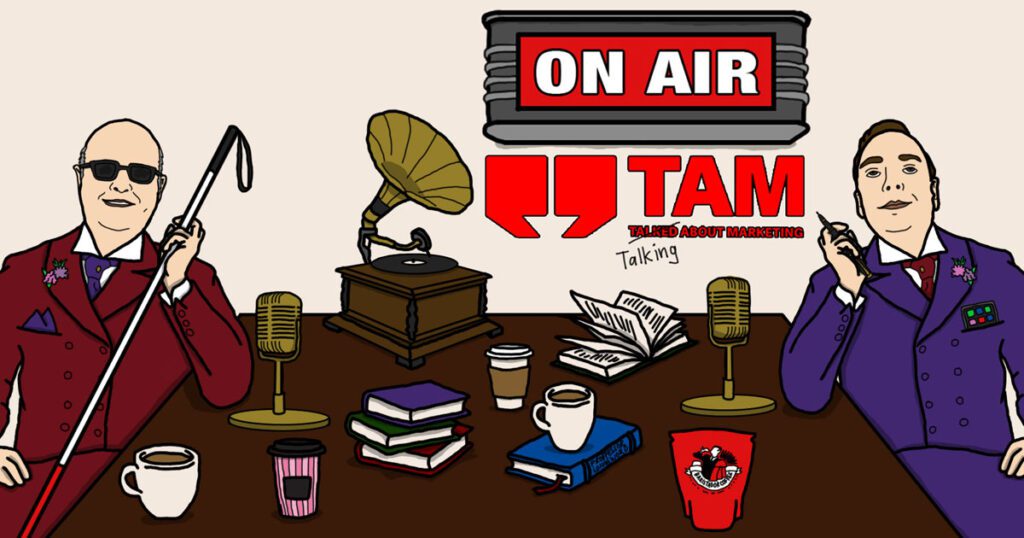
From a keyboard warrior calling Steve a snooker player, to a comedy dry cleaner called Touching Cloth, this episode asks whether your business name is doing you any favours, or just quietly touching cloth of its own.
A lamb ad and a locked-profile troll teach Steve and David the same lesson: the pause is the whole trick, and social media is built to make you skip it.
A British comedy sketch about a dry cleaner called Touching Cloth becomes the unlikely launchpad for Mini Steve’s business-naming principles, tested live and mostly agreed with.
A client’s expired domain name turns into a lesson about renewal traps, Melbourne IT’s pricing, and the difference between penny-wise and paranoid.
An organ donor ad about the world’s biggest asshole gets the Perspicacity treatment, with a verdict on whether shock still works when the target audience has gone numb to it.
Get ready to take notes.
Talking About Marketing podcast episode notes with timecodes
02:00 Person This segment focusses on you, the person, because we believe business is personal.
The Pause That Saves You From Yourself
Steve opens with a confession disguised as a question: has David ever fired off an emotional comment online, or been on the receiving end of one? David has, and it wasn’t pleasant. Neither host thinks the commenter would have said it to their face, which is really the whole problem in one sentence.
From there, a lamb ad supplies the unlikely proof of concept. The ad restages a real comment section as a portable grandstand, strangers hurling abuse at each other over nothing, until lamb arrives and somehow calms the mob. David’s read cuts straight to the point: the redirection doesn’t need to be profound, it just needs to be better than the dumb thing people are already doing.
Steve connects it to Jill Bolte Taylor’s Whole Brain Living and the 90-second window before an emotional reaction locks in. He’d had his own test that week: a stranger with a locked profile telling him to stick to snooker, a lame pun on his name. He didn’t bite, because the algorithm wants the reaction more than it wants him to be right. Turning the other cheek, in this case, isn’t weakness. It’s refusing to feed the beast.
14:00 Principles This segment focusses principles you can apply in your business today.
Touching Cloth and the Business of Naming Yourself
A comedy sketch about three well-meaning entrepreneurs naming their dry cleaning business Touching Cloth (a name with an unfortunate second meaning involving cloth, poo, and a failure of restraint) becomes the launchpad for testing some business naming principles. David’s take on the sketch is blunt: the comedy comes from watching well-meaning people talk themselves past an obvious problem, out loud, without noticing.
Steve turns to Mini Steve, the AI model trained on his blog archive, to stress-test some naming principles, and finds himself agreeing with all of it. Say the name aloud to a stranger on a bad phone line. Check every handle and domain before falling in love with anything. Search the trademark register before you print a single business card. Avoid clever misspellings, since everyone types the correct version first and wonders why you didn’t.
The sharpest distinction is descriptive versus distinctive. Descriptive names explain what you do and help with search from day one, but they’re hard to trademark and easy to blend into the background. Distinctive names cost more to build meaning into, but once they mean something, that meaning is yours alone. Either way, the name’s job is to be memorable and spellable, not to carry the whole value proposition. That’s what the website and the tagline are for.
26:00 Problems This segment answers questions we've received from clients or listeners.
The $108 Lesson in Domain Renewal
A client let a valuable domain name lapse and asked Steve, a day after it had expired, whether she should renew it. She should, because the test is simple: how would you feel if a competitor grabbed it? Terrible, she said. Renew it.
The real sting was the price. Her domain was registered with Melbourne IT, which charged $108 for a single year of a .com.au domain, against roughly $24 to $25 elsewhere. David’s read is that reputation pricing like this survives only while people don’t do the research, and that window is closing. Steve draws the comparison to scam invoices dressed up as official renewal notices, official-looking, fine print disclaiming everything, designed to catch harried business owners at exactly the wrong moment.
Nobody’s going broke over $108. But looking after the pennies, as Steve puts it, still says something about how a business runs.
30:30 Perspicacity This segment is designed to sharpen our thinking by reflecting on a case study from the past.
The World’s Biggest Asshole, Revisited
This episode’s Perspicacity ad is 2016’s The World’s Biggest Asshole, made by the Martin Agency for Donate Life America. It spends its first 45 seconds building an unlikable man before revealing he was an organ donor. The numbers are real: daily registrations jumped roughly 625 percent in the first week, and video views passed 100 million by 2017.
David’s discomfort with the ad hasn’t shifted. Shock tactics might move a specific, angry audience, but they skip the harder work of building a genuinely positive case for organ donation. Steve agrees, with a caveat: the word that felt edgy in 2016 might not land the same way on an audience that’s grown numb to shock.
Where the segment gets interesting is the alternate version David would rather make: same unkind man, same list of harm done, but built toward one act of kindness nobody expected, and the people that kindness reached. Steve pushes the idea further, framing it not as proving someone was secretly kind, but as telling him plainly that he’s allowed a second chance to be seen as more than the worst thing he did.
Transcript This transcript was generated using Descript.
A Machine-Generated Transcript – Beware Errors
S09E04
Caitlin Davis: [00:00:00] Thinking about Marketing is a podcast for business owners and leaders, produced by Steve Davis and David Oldney of Talked About Marketing. More than 8,000 conversations have taught them something. You can’t read the label from inside the bottle. Everyone needs external perspective. Through their four Ps, person, principles, problems, and perspicacity, yes, you heard that correctly, they explore marketing with curiosity, generosity, and the occasional gentle eye roll.
They hope this becomes a trusted companion on your journey in business[00:01:00]
Steve Davis: David, once upon a time, I’m sure in your life, have you left a comment on a social media post that was triggered by just your emotional response?
David Olney: I would say definitely yes, but I can’t remember a specific occurrence.
Steve Davis: Have you been the recipient of such comments?
David Olney: Yeah. It wasn’t pleasant.
Steve Davis: Hmm. Why do we do this to ourselves?
Do you think the person who left that comment would’ve said it to your face?
David Olney: No.
Steve Davis: Hmm.
David Olney: And the reason I didn’t respond to them is ’cause they hadn’t said it to my face.
Steve Davis: Ironically, I’ve got some comments to share
Caitlin Davis: Our four Ps. Number one, person. These are insights for the whole person, not just the business operator. Oscar Wilde put it this way, “The aim of life [00:02:00] is self-development, to realize one’s nature perfectly. That’s what each of us is here for.”
Steve Davis: In the person segment, we’re doing something a little bit different this time.
If you’re a regular listener to Talking About Marketing, you’ve, you know that we normally finish each episode in the post-picassily segment with an ad. We still have one to talk about later, but we’ve got one to kick us off into the person discussion this, uh, this episode, and it’s a long ad, isn’t it, David?
David Olney: Yeah, I kept waiting for it to get to the point. I knew it would eventually.
Steve Davis: Imagine this. Uh, we’ll put the, the actual video in the show notes so you can watch it, but what we’re gonna hear is some people showing off a beautiful prize dog, and then suddenly the camera pulls back, and we see the comment section, which is this portable grandstand full of people who just hurl out their comments, replicating life in social media.
All the comments you [00:03:00] hear have actually come from real posts in social media. Uh, it’ll make itself clear. Just strap in for a couple of minutes.
TV Ad: What do you reckon?
Don’t know. And check. Oh my God, that’s the funniest thing I’ve seen all week. No notes. Who would do that to a dog?
That looks like a dog I drew in grade two. @GinaSmith, this is literally you.
It’s literally me.
Everyone calm down. It’s fake.
Wow, this comment section is getting toxic. Do
you think this is happening
everywhere?
The environment
We’re saving the environment
They only work when there’s enough wind
I made $5,000 in a week working from home with this one simple trick
I love renewable
CO2 is perhaps the near [00:04:00] lowest in Earth’s history
Yeah, right.
Next thing you’ll tell me the Earth is flat.
See? Flat
as. This proves nothing. That could be AI. No, that’s
AI. It’s achievable naturally.
I have a body similar to that. Looking good, Koschie. I made $5,000 in a week. Shut up.
And that’s the way you make the perfect cuppa.
Milk before tea? This is a crime.
Same as with cereals. Milk first. You are a psycho.
Guys, it’s not real. Oh, we’re fighting over tea now.
Could be worse.
How?
She broke dancing
I don’t get it
If cringe could kill you, this would be a lethal dose Oh, another keyboard warrior @
GinaSmith literally not you
So not me
It’s fake
Why is everyone hating? It’s fake She [00:05:00] sucks You suck Blocked and reported Blocked and reported Blocked and
reported Blocked and reported World tour please La la la la la Moron It’s fake. Everyone relax. It’s not real
Fail fail democracy Dumbest sport
ever. What’s next? Dog grooming? Screw you Whoa Sorry.
I just got caught up in whatever this is
There’s gotta be something that unites us. Oh, yeah
Everyone, get out of the comments and into
the comments
Oh, I am such a ditsy Betty Look at adore- I’m in a big old griddy gun Now this is real Gina Smith, it’s literally you Oh my God, it’s me, Gina Smith. Ah.
Wait, why
is everyone being so nice?
I think everyone’s a lot nicer in real life than we are online.
I [00:06:00] guess the anonymousness of the internet promotes disagreements, and the platforms that we-
Yeah,
we get it.
Just ate some lamb
I hope people post nice comments about this ad
Steve Davis: Whether you eat lamb or not I think there is great genius That the people, uh, behind the lamb ads tap into, and what they always tap into is what brings us together. It runs counter stream to basically everything else in media, ’cause everything’s about conflict and what drives us apart, and they set up with that, and then they bring lamb as the, the bonding.
I think we played another one of their ads many years ago where they’ve got all the different religious leaders from around the world, and they’re poking fun at each other. And then where diet is [00:07:00] normally the thing that divides religions, lamb was the one meat that almost all of them can eat, uh, except the Buddhists.
Um, so this one is different because what we’re doing here is lamb is coming to the fore to get people out of themselves to look at something they enjoy together. And you see enemies who before were keyboard warrioring against each other, high-five and bond over lamb. It’s fanciful to some degree, but I actually think there’s truth in it, David.
David Olney: I think the really powerful idea is that a redirection doesn’t have to be huge, deep or meaningful. It just needs to be better than the dumb thing that people are currently doing. Like lamb is nice, but it could’ve been any number of things, but the redirection is often all people need.
Steve Davis: It reminds me of something an author said in one of the books we’ve read in recent times, [00:08:00] and I think it was Whole Brain Living.
David Olney: By Jill Bolte Taylor.
Steve Davis: By Jill Bolte Taylor. There’s part… One of the things she said in thinking about from her actual brain research without four dominant quadrants, especially quadrant number two that she referred to, which is the defender that wants to completely go into fight, flight and, and whatever mode.
David Olney: Catastrophize, yep.
Steve Davis: Um, that if you actually breathe for 90 seconds, the chemical reactions that are producing- Yep … this emotional state have a chance to be moderated. What we have online is the hackles get up either just out of pure mischief and just being an a-hole, or because it’s tapped into a raw nerve, and instead of breathing it through in the way that would happen if you were face to face with someone most of the time, the keyboard can just shoot it out.
Whereas what the lamb ad is doing, and it [00:09:00] even says it ni- does it nicely at the end, they pass the lamb cutlet to the woman. She slowly holds it, slowly bites it, slowly eats it, and then the thumb goes up. It’s almost, I’m not sure how much they researched this, but it almost mirrors that pause that you need to let the emotional charge go through
David Olney: Hmm.
And I think it, it taps into what so often happens in social media. You’re thinking about your response, and then another weird comment comes through. You’re looking at that comment and get a bit more riled. You’re thinking about how to respond, then the next weird comment comes through, and by the time you start responding to comments, there’s 10 or 15 weird comments, and it’s like, hang on, hang on, hang on.
If I don’t cut away from this now, I become part of this onslaught of my device going bong, which like Pavlov’s dog, makes me pay attention to the device, and I get another little dose of outrage. So really, in almost every situation in life, you know, a pause is a beautiful thing.
Steve Davis: It’s almost like these [00:10:00] little screens that we’re be- are enslaved to, and the social media layers that work within them, it’s a constant test of whether we are adult or not.
I had that experience this week. I questioned SA Water with some particularly pertinent information about, uh, a report I just saw of the toxin levels in the Port River system, and the person at SA Water replied and said, “Look, that would be the EPA, the Environmental Protection Authority. Talk to them.”
That was fine. Job done. I’m going to be talking to them. However, randomly, a day or so later, someone chipped in. I don’t know who he is. He’s got a locked profile. Just said, “You should stick to playing snooker.” Which is their joke ’cause my name’s Steve Davis.
David Olney: Yeah.
Steve Davis: It’s just the lamest attempt at trying to do a dad joke.
We’ve got no connection And the adult [00:11:00] test for me is that as much as I wanted to just gently, um, mark him down for his attempt at humor- Or
David Olney: insert a pool cue somewhere …
Steve Davis: I realized that all Mark Zuckerberg wants is for me to react because the algorithm has action, more people get to spend more time to be exposed to advertising, and I feed the beast.
Mm. And he wouldn’t care what I said in return. It, it leads nowhere. And so I’m just adopting that mindset that it’s my little test. Am I adult mode, or am I gonna give in like a sniveling little kid and be sensitive to every slight in the world? Because sadly, that’s what social media channels want us to do.
And as part of the person segment, thought we’d share this because it’s just that timely reminder. Those annoying, [00:12:00] um, uh, emails that are spam that you just want to answer back because it’s so hideous, or those text messages, “Hey, uh, Dad, I’ve lost my phone. Can you call this number instead and send me money?”
You wanna go back and give them what for, but it just feeds their game. Mm. We have to learn to turn the other cheek and be adults in the world, David.
David Olney: Mm. Absolutely. And for book ideas for next time-
Steve Davis: Mm …
David Olney: uh, I sent you an email summary of it. Um, The Ingredients of Emotional Maturity by The School of Life.
Taps into exactly this point of we can become physically mature just by being alive. But being physically mature doesn’t mean you become emotionally mature, and what do you have to do to become emotionally mature?
Steve Davis: There was one other book that we have talked about on this podcast a long, long time ago.
It started with that story, the beginning of going up the mountain, going very [00:13:00] slowly. It was by a behavioral economist or psychologist, David, and it was out of that that arose one of the ways of dealing with when you’re stressed is to reframe it.
David Olney: Mm.
Steve Davis: And picture it perhaps as a swell in the ocean that you’re gonna surf over.
David Olney: Mm.
Steve Davis: And ride it. Don’t get drowned by it.
David Olney: Mm.
Steve Davis: This is one of those areas where I, I think both the lamb ad with the comments and the thing that I had, and other stuff, is just a reminder for us to, to thicken our skin and to ignore it, because to do anything else just puts kerosene on the fire.
David Olney: Yep, ’cause you’re dealing with someone who doesn’t want to step away, and you can only reason with reasonable people.
Caitlin Davis: Our four Ps. Number two, principles. These are ideas worth building on. [00:14:00] As Oscar Wilde reminded us, you can never be overdressed or over-educated.
Steve Davis: You finished the last segment by saying reasonable people, David. Often reasonable people have a business idea. So in the principles segment, I want to play a little snippet of a comedy segment from the UK from a number of years ago of some people sitting around trying to plan a dry cleaning business and working out what the business name is.
Let’s have a listen.
Touching Cloth: Well, well that’s brilliant. Thank you. Great news, guys. The bank have agreed the loan.
Oh, that’s great.
Yay. So now we can go ahead and start up our own dry cleaning business. What shall we call it?
Well, I think it should definitely be a funny name.
Yeah, a, a funny name, like a hairdresser’s that’s called Fringe Benefits or A Cut Above.
So what would one for a dry cleaning shop be?
Well, [00:15:00] I’ve had a thought, actually. I mean, I think it’s funny. It’s certainly a phrase I’ve heard, but I’m just not quite sure what it means. It’s touching cloth. Oh,
great. Touching cloth. Yeah, that, that’s certainly a phrase I’ve heard.
It’s got a ring to it, hasn’t it?
Touching cloth.
Yeah. So, so what does it mean?
Well, obviously part of what it means is what we would be doing. You know, as dry cleaners, we’ll spend most of our day touching cloth.
Yeah. Yes, and of course, our customers who bring in their clothes for us to dry clean, they’ll all be touching cloth as well.
You know, as they hand the clothes over, they’ll be touching cloth.
Well, great. That all works out brilliantly.
And what’s more, what I think will make it funny is that I think that touching cloth has a double meaning. It’s just I’m not quite sure what it is.
Right. Well, well that’s great, but I think it’s probably quite important that we find out exactly what the other meaning of touching cloth might be before we call the sign writer or get the notepaper printed.
Yeah. Does anybody know what the other meaning of touching cloth is?
TV Ad: I know. [00:16:00]
Touching Cloth: Oh, great. Is it funny?
TV Ad: Yes, it is. It is funny.
Touching Cloth: What is it?
TV Ad: Well, when you’re touching cloth, what you’re doing is that you so need a poo- … that you’ve sort of started to poo yourself- … but you’ve managed to stop at the point where a bit of the poo is actually touching the cloth-
of the inside of your pants.
Touching Cloth: Oh, right. I had no idea there was a name for that.
TV Ad: That is funny, and it’s funny because it involves poo.
Touching Cloth: Yes, it is very funny.
My only slight worry, is the association of getting poo on clothes, whi- which I agree is funny- … is that association appropriate for a business such as dry cleaning, which is, after all, supposed to be about getting clothes clean?
TV Ad: Oh, yeah.
Touching Cloth: But, but I don’t think it’s really a problem.
Yeah, you can worry too much about these things.
TV Ad: And the way I see it, there’s an upside, because the message we’ll be sending out is [00:17:00] even if you have got poo on your clothes, we can handle it. In fact, we could call it Touching Cloth, question mark.
Touching cloth? Then step this way.
Touching Cloth: I really like that.
Steve Davis: Would you take your clothes to Touching Cloth, David?
David Olney: Oh, I think I’d be more worried about the people than the name. Like, I didn’t know that dry cleaning chemicals were hallucinogens.
Steve Davis: Isn’t it interesting? It feel, that whole segment, the comedy comes from the fact That we’re watching a train wreck-
David Olney: Mm …
Steve Davis: in action.
Well-meaning people, and they’re speaking all their thoughts out loud, uh, overdone of course, on purpose for effect, and that’s what makes it a poignant study, I think. It’s like, you know, an animal developed by a committee would be something like a camel. I’ve heard that talked about before. Mm. Everyone wants their two bob’s worth.
But here it’s a bit [00:18:00] different. They’re willfully being blind towards some obvious issues with their name, trying to make the example of a stool touching your clothes somehow not feel icky and not repel someone from going to your shop.
David Olney: And I think the third thing that they don’t talk about is what would it be like to work in the dry cleaning store, where the only work you get is removing poo off of clothes?
Yes. Like, the sheer horribleness of the imagery, the fact that they managed to deliver that, you know, that segment- Yes … without breaking up.
Steve Davis: I wonder how many takes it
David Olney: took. Oh, that is a very talented bunch of people to make something so disturbing.
Steve Davis: Uh, and of course, it’s in the show notes if you wanna watch the video.
So what I thought I’d do is put Mini Steve to the test. We talked about Mini Steve last episode. It’s a mini version of me and David distilled at-
David Olney: Yeah, there’s bits [00:19:00] of me, but there’s a lot more blog posts from 2004 onwards than there is podcast stuff. That’s right. So it’s, it’s far more Steve than me, but over time, or as we refine Mini Steve further- Mm
uh-oh, it’s gonna become a hybrid.
Steve Davis: And it’s there to help our smaller clients who just need those little questions to pepper any day, uh, 24 hours, seven days a week, and to get an answer. So I thought I’d put it to Mini Steve. I said, “Here’s a side question. If we were starting a new business, what principles help with business name selection?”
And blow me down, David, I actually concur with everything Mini Steve said.
David Olney: It did a lovely job. It’s proof that all that material wasn’t in vain, and that you’ve been speaking quality answers for a very long time.
Steve Davis: What I love in particular with, um, Claude, which is running this app, is Claude is honoring my harsh directive to stay within the content I’ve given it, not go beyond it.
So that’s heartening to me. Mm. Anyway, here’s a few ideas if you are thinking about a [00:20:00] business name. First of all is say it out loud to a stranger over a bad phone line. That’s a great analogy, because you’re gonna have to do that if you’re answering the phone over and over again. And if you get, “How do you spell that?”
Which I get with my street.
David Olney: Mm.
Steve Davis: You know, which it’s a bit harder when you’re choosing a house, because you think, “If I have to call an ambulance- How do I, in panic, tr- spell this name? Um, but a business name is different. A business name, you’ve got control over. So I think that’s a good first point. You concur with that one?
David Olney: I utterly agree.
Steve Davis: Secondly, check the domain and all the handles before you fall in love. This is not just is the .com, .au available, and the .com, et cetera. Look at the Facebook page. Mm-hmm. Look at the Instagram handle. Look at the Google Business Profile listing. If it’s already taken, even by an unrelated business, you’re gonna be competing with them in search forever.
TV Ad: Yep.
Steve Davis: And check ASIC’s business name [00:21:00] register, um, IP Australia’s trademark search too, before you print anything. I think that’s wise. They would’ve, oh, I, I don’t know, Touching Cloth probably wasn’t taken, so that one wouldn’t have helped them. Uh, but it’s useful to do. “Don’t name yourself into a corner,” says Mini Steve.
He said, “If you were gonna set up Darwin Barra Charters,” um, this is, Mini Steve has been paid for a fishing client of ours up in Darwin. They’d say, “Look, it’s clear and searchable right up until you wanna run reef trips out of Broome.” So geographic and product-specific names, you know, they buy you early clarity, they might cost you later flexibility.
David Olney: And I think this is very important for the Touching Cloth example, is even if you start as the dry cleaners who are, are more than happy to get poo off of clothes-
Steve Davis: Mm-hmm …
David Olney: do you want to stay in that business?
Steve Davis: Yes.
David Olney: Probably not.
Steve Davis: Of all your options, it might soon be your number two. Um-
David Olney: [00:22:00] Better than your number one.
Steve Davis: Now, th- Mini Steve does say that sometimes, though, that trade is worth it. A local trades business probably should have the suburb in the name. A business that might expand or diversify probably shouldn’t. Yes, that’s cautious. Avoid the clever spelling trap.
TV Ad: Hmm.
Steve Davis: So doesn’t this make you just rankle?
“Dropping vowels or swapping a C for a K to get the domain is a permanent tax,” says Mini Steve. “Everyone types the correct spelling first.”
David Olney: And more importantly, they wonder why you didn’t. So it’s not just the case it makes your life harder, it makes people assume there’s something wrong with you.
Steve Davis: Descriptive versus distinctive is a real fork. Descriptive names like Adelaide Roof Restoration tell people what you do, and they help with search from day one. They’re hard to trademark though, and they’re easy to blend in with anything else. Distinctive [00:23:00] names like Humbug or Xero or Patagonia, they need marketing investment to mean something, but once they do, they’re yours alone.
So for a small local service business, uh, descriptive usually wins. Something you intend to build and brand, uh, maybe distinctive is worth thinking about, but it’s a harder start. A name doesn’t need to explain the business. It needs to be memorable, spellable, and not actively misleading. The tagline and the website actually do the explaining.
People burn weeks trying to cram the whole value proposition into two words.
David Olney: Hear, hear, David. I like things that happen in two words.
Steve Davis: Yes, but sometimes if it’s the business name, it’s not everything.
David Olney: No. No, we have more words than two available.
Steve Davis: And look, to be honest, this comes up in conversation quite a lot.
The reason you have a website is to have all those words captured. That’s where the AI tools, the search tools get their teeth into.
TV Ad: Mm.
Steve Davis: The business name has some value, don’t get me wrong, but [00:24:00] That’s the tip of the iceberg. The actual content is the iceberg, and references to you from third parties is the co- is where the substance comes.
I feel like I’m sounding a bit preachy in this, David. I’m gonna try and relax for the last few. Check the accidental meanings. So this is your touching cloth scenario. Um, say it fast. Read the domain as one unbroken string of letters. That’s where the famous disasters live. Google it alongside your industry, see what comes up.
Good tip. There was, there was something, there was some sort of company that was pool and- Oh, yeah. I remember you telling me that … and garden or spa. Yeah. And it looked like pool land. Yes. And you just want to be aware of those accidental meanings. And then the last thing little Steve or mini Steve says is, “Then stop.
Names matter less than people think. Plenty of good businesses have mediocre names, and plenty of terrible businesses have great ones. Pick something clean, check it’s [00:25:00] legally and digitally available, and get on with the actual work.” Uh, one thing worth adding, says mini Steve, this is weird quoting myself in the third person here.
If the name is genuinely tied to positioning, where the name itself is doing strategic work rather than just labeling the thing, that’s a different conversation and one worth having with Steve properly rather than solving in a list.
David Olney: All sound sensible to me. So- And just remember, you are what will give the name value.
Yeah. The name won’t give you value. ‘
Steve Davis: Cause you can have the smartest name, everything beautiful, and if someone’s experience with you is horrible, that’s what they’ll be talking about.
David Olney: Mm-hmm.
Steve Davis: Yeah. Uh, it’s a tough gig, this world of business, isn’t it? But if it was too easy, everybody would be doing it and doing it successfully.
David Olney: And we wouldn’t have to create a mini Steve to help them.[00:26:00]
Caitlin Davis: Our four Ps. Number three, problems. These are the marketing challenges keeping you up at night. As Oscar said, we ask questions for the best reason possible. Simple curiosity, no hidden agenda, just genuine interest in what’s actually happening.
Steve Davis: In the problem segment, oh, I’m gonna tr- you have to get your big stick out, David.
Get your cane and poke me off my pedestal here, ’cause I’m going to be a little bit angry.
David Olney: That’s okay. You’re allowed.
Steve Davis: A dear client who i- is a bit like me, when they think of a really good domain name that could be very helpful for their business, they will grab it, and I can’t throw the first stone there, David.
I’ve lost count of what domain names I have. I shudder to think. But this one came up for renewal, and she emailed me and said, “Should I [00:27:00] renew it?” And unfortunately, she asked me a day after it had expired, so it’s now in the grace period where you’ve got a few extra days. But you cannot move a domain name that’s expired in that situation without paying the current registrar and then moving it.
And the trouble is, it’s a decent name. She hasn’t been using it, but I said, “To me, the litmus test is, how would you feel if a competitor started using it?” And she said, “Terrible.” I said, “Well, you have to renew it.” The big mistake she made, she had registered it with Melbourne IT. Now, they have their fans out there.
I have never been one, because the renewal was $108 for one
.com.au domain name for one year Most places, Venture IP, for example, it’s around 24, [00:28:00] 25 bucks. I have never understood that tax. I mean, they were one of the early companies back when the web world was truly the Wild West, and people just plucked numbers out of their backsides. Um, I don’t think it’s… I mean, they’re strategically important, but they are a small signal that costs nothing for those companies to maintain.
David Olney: Again, they believe that their reputation will get them over the line of charging like that, and it won’t, because people will do the research and go make sure you pay this before it’s overdue, so you can move the registration.
Steve Davis: Yeah, it’s… Some people will do the research, and sadly, others don’t.
David Olney: They- I think more and more it, it’s going to be that research will become normal.
I think what we’re seeing is we’re seeing things like this with clients who remember when you couldn’t get information on lots of these things. So it was either ask us or leave it to the last minute [00:29:00] and miss opportunity. So I think this is something that will change over time, and people at Melbourne IT will get punished over time.
Steve Davis: And so, and then, see, the thing is, at that rate, they’re not dissimilar from the actual scoundrel companies that go out there, and they send letters that look like official invoices, um, uh, business registration letters, and domain renewal letters. It looks official. In fine print down the bottom it says, “This is not an invoice,” and we’re just, you know, a- after your business, hidden away.
And there are gonna be rushed, harried people-
David Olney: Mm …
Steve Davis: in small business who pay it, and then they’re locked in to that sort of Melbourne IT level- Mm … extortionate pricing. Really sad. Really, I mean, w- will she go broke because of this? No. It’s more a principle thing.
David Olney: Mm.
Steve Davis: And, you know, I do like the idea of looking after the pennies, so the pounds will look after [00:30:00] themselves.
Uh, whether or not that’s held by many people, I just think it’s, shows prudence if you’re not being taken to the cleaners. ‘
David Olney: Cause we’ve talked about cleaners already, and it ended poorly.
Steve Davis: And at that pricing, that is certainly touching cloth.
David Olney: Very definitely.
Caitlin Davis: Our four Ps. Number four, perspicacity. Let’s examine a campaign from the past and ask, would it work today? As Oscar Wilde believed, our one duty to history is to rewrite it. So let’s see what we can learn.
Steve Davis: Let’s bring this episode to a close with the Perspicacity segment. We have another ad, so a bonus, two ads in this episode.
Isn’t it interesting? When we watch some TV, uh, I think it’s Prime or whatever, we have ads, and we want to avoid them. [00:31:00] But when it comes time to doing talking about marketing-
David Olney: Suddenly we need to find them.
Steve Davis: We love them. Anyway, I’ve got an ad here. I think it’s fairly self-explanatory. Um, the, the actual video is on the show notes.
But basically, you’ve got a guy who is an absolute A-hole, as they call him, in the ad, and there’s lots of scenes of him driving his huge truck, drinking beer, giving cigarettes to kids. You know, he’s, he, he’s one of- He’s an
David Olney: unlikable entity.
Steve Davis: Absolutely. I think if you know that, you’ll make sense of the ad.
Does that all right?
TV Ad: This is a story about Coleman Sweeney. Coleman, in short, was an asshole. Everyone in his small town knew it. It wasn’t that he tried particularly hard to be unpleasant, it just seemed to come naturally to him. Coleman felt like the whole world owed him something, which caused [00:32:00] him to regularly ignore the rules of a decent, acceptable society, and he hated anything that got
in his way.
Go. Go, you got it. You got it, go. Go, go, you can
do it. And small animals. Even to children, he was an asshole. Trick or treat. He was, as they say, born to it. But then- The early bird special … the strangest thing happened. It’s $3. Something entirely unexpected. Coleman Sweeney died. A brain aneurysm. Well, subarachnoid hemorrhage- Sir?
to be more specific. Hello? Call 911. And it came as he argued over whether- Hello? … extra fries should be included in a $1.99 early bird breakfast, which was a typical Coleman Sweeney play. Get out of the way. Let’s go. Hit it. It was then that Sarah found something completely unexpected. Coleman Sweeney had registered to be an organ donor.
Oh, my God. Nobody knew what caused Coleman to do it, but there it was, generous and majestic. [00:33:00] And that was the day that Coleman went from asshole to hero. You see, his liver went to Stan, a father of two. His heart went to Miranda Morgan-
Touching Cloth: If you here have been to this school- Who
TV Ad: went on to teach for 25 more years
you
Touching Cloth: have
TV Ad: my respect. And his tendons went to Staff Sergeant Donahue, who was able to walk again, and would never need to be pushed across the street by his physical therapist. And in a moment of small world irony, his corneas went to his 82-year-old next-door neighbor so that she could finally see the crap that her dog made in the side yard and pick it up.
Yes, in life, Coleman was a bonafide asshole, 365 days a year, 24/7.
Hey, bye Ray. But
in death, well, let’s just raise our middle fingers and shout, “Up yours, Coleman Sweeney. You’re not an asshole anymore.”[00:34:00]
Steve Davis: How interesting, David, and how brave for the organ donor movement To go out there on a limb with an ad that for the first 45 seconds would have people shocked and almost poised to write a letter to the editor, David.
David Olney: Yeah, and that’s my concern with it, is I really think if we look how low the organ donor rates are in a lot of countries.
You know, the countries where organ donor rates are high are the ones where the assumption is when you get your driver’s license, you’ll donate unless you tick the form to say you won’t. So that’s the only way to get higher rates of donation. But to try and use this kind of negative approach to sell something that people are already largely uncomfortable about, to not spend the time on the other side, “All right, he’s an organ donor,” but really to invest in [00:35:00] that side and build a really positive message about organ donating, about organ donation.
I, I don’t really think it works.
Steve Davis: Interesting, David, ’cause my intuitions are similar to yours, and I just looked it up, and there’s a little bit of data here. The ad was called The World’s Biggest Asshole. It was made in 2016 by the Martin Agency for Donate Life America.
TV Ad: Mm-hmm.
Steve Davis: And it was explicitly aimed at persuading younger men, especially millennials, to register rather than simply raising awareness.
Um, they’ve… I’ve got some published outcome figures here. All right? Online registrations to the National Donate Life Registry, uh, before the launch, they were getting about 149 per day.
David Olney: Mm.
Steve Davis: Immediately after launch, about 1,080 per day during the first week, which is roughly a 625% increase in daily- Mm
registrations. Total [00:36:00] online registrations before launch, no data. Um, but immediately after launch, it was reported as 698% higher than the preceding week. M- We just don’t have the actual figures. Registrations among millennial men, again, no data, but it, uh, they reported that the peak days reported up to 1200% above normal.
So that’s 12 times. Mm. And video reach, no data, but 50 million views in the first week and over 100 million views by 2017. Um, so according to Perplexity AI, which did the research to f- gather that for us, it said those figures indicate it did produce a substantial immediate increase in online donor registrations, not merely views, likes, or stated intentions, but registrations.
David Olney: Mm. And to me, the key thing here is now we know which audience it was created for-
Steve Davis: Mm …
David Olney: and that it would’ve been targeted to them on the right channels. So the point is, you and I [00:37:00] wouldn’t have encountered that ad because w- you know, we weren’t the target audience. So what it says to me is I’m really sad that that ad worked on that target audience.
But good marketing is about understanding your target audience and communicating in a way they understand and that makes them take action.
Steve Davis: Hmm.
David Olney: So I’m, I’m glad an agency worked out how to get through, but I’m sad that that audience responded so well to an ad that I do not believe would’ve worked on other demographics.
Steve Davis: Yes, you’re probably right. We… It might not have come into our channels. Although often, Dave, when I go to pick you up, you’re sitting out the front in your big pickup truck. You’ve got a piece of straw in one hand and an open bottle of beer in the other, um, listening to country music. I would’ve thought you would’ve seen it.
David Olney: Yeah, it’s surprising I didn’t. Yeah. And it’s surprising that me and the truck never get to go anywhere. Yeah. So I have to sit in my truck and wait for you to turn up in your sensible vehicle.
Steve Davis: So here’s the big question for perspicacity. [00:38:00] Would an ad like that work today?
David Olney: Horribly, if you imagine the target audience, which are essentially the young angry males that voted Donald Trump in 2016, yes, it’d still work on the same group of people And they are still a group of people that make me sad about the so- sad about the state of society
Steve Davis: The only, uh, my intuition is the same.
The only caveat I would put to that is, in 2016, using the word asshole in an ad would’ve been really edgy and out there.
David Olney: Mm.
Steve Davis: Is this cohort too jaded that that would mean nothing, and they’d have to push out even further?
David Olney: Quite possibly. Th- this is an ad where it’s strange. Often when we talk about these perspicacity ads, we don’t really talk that much about what we’d do instead.
Steve Davis: Mm.
David Olney: But [00:39:00] the version of this ad I would love to make to help with organ donation is this is Blah. In li- in life, Blah was not a kind man. And then you can have all the things, you know, the, the, the drunk driving, the giving out cigarettes to kids. You can keep reporting, in life, he wasn’t a kind man. But he made one kind decision, and the people who were affected by his kindness will never know, and then spend 30 seconds on all the people that his organs helped.
Like, I would love to do a better version of this ad for all demographics. I think that would be really interesting.
Steve Davis: Yeah. Or is it that inside these men we worry about, there is a little kid in there that wishes it didn’t have to be like this, that we could speak to in some
David Olney: way. That’s why I think the kindness ad, why I want w- wish we could make it for some sort of organ donation organization, to prove that talking to the mess-
Steve Davis: Yeah
David Olney: is [00:40:00] unnecessary. You can talk to the person.
Steve Davis: And I actually, I would tweak that even further and change the framing to say, everybody thinks such and such is this and
David Olney: that. Was an unkind man. Yeah.
Steve Davis: So, uh, because he doesn’t wanna necessarily be out there being labeled kind.
David Olney: Yeah.
Steve Davis: But if everyone thinks, what we’re doing is we’re saying to him, “We know you’re getting judged harshly, sometimes validly, it’s often not.
But there is one thing, deep down, that you did right- Yeah … and it was this.” And I feel that somewhere in there, David, is the, is the seed for having a second shot at this. A really
David Olney: good campaign.
Steve Davis: Yeah.
David Olney: Yeah. That would be good because you could show it on all channels to all age groups.
Steve Davis: Well, that’s true, and it might even have a little bit of societal impact.
David Olney: You would hope.
Steve Davis: That’s all better.
David Olney: So as opposed to something that obviously did work, but- All it did was, I don’t know, it just, it got there [00:41:00] through negativity. Mm. Once again, it got there through negativity. Why does that have to be the default?
Steve Davis: Well, let’s finish on a positive note. If I, I’m an organ donor.
David Olney: Me too.
Steve Davis: And if you had to pick of the board, which bit of me would you like in your body?
David Olney: I’ll have your eyeballs. I wanna be able to drive that monster truck.
Steve Davis: Yeah. Okay. Uh, do I get to pick something from you?
David Olney: Absolutely.
Steve Davis: Hmm. I think I’d like your right wrist, the one that holds the cane all the time.
David Olney: Yep.
Steve Davis: ‘Cause there’ll be some darn strong muscles in that.
David Olney: Well, connected to it. You might need my whole forearm.
Steve Davis: Okay. I’ll take the whole- Have,
David Olney: have my right forearm.
Steve Davis: All right. Thanks. Job done. Can we add it on our little v- donor thing that we’ve e- elected from s- Or I can bequeath it to you.
David Olney: Oh, we’ll have to put it in our wills.
There you go. It’s gonna get weird, but it’s okay.[00:42:00]
Caitlin Davis: Thanks for listening to Talking About Marketing. If you found this helpful, please share it with someone who might benefit, and if you’re so inclined, leave a rating in your podcast app. Both help more than you think. Steve and David welcome your thoughts, which you can send to podcast@talkedaboutmarketing.com.
That’s podcast@talkedaboutmarketing.com. Want to continue the conversation beyond the podcast? You can book 20 minutes with Steve at talkedaboutmarketing.com. No cost, no obligation. And we’ll leave the last word to Oscar Wilde, “There’s only one thing worse than being talked about, and that’s not being talked about.”