Whether it’s a book on communicating in small steps, a Godzilla prompt that wore out two teams or a bot army posting about talking onions, this episode shows that AI pays off when a person starts the work, polishes it and makes the final call.
From a gentle book about communicating one small step at a time to a Godzilla prompt that wore out two teams, we explore why AI works best when a human starts it, polishes it and stays awake for the judgement call (and what happens to a bot army when nobody does).
Communication starts small. David gushes about Vinh Giang’s new book on becoming a better communicator without leaving your comfort zone for long.
David confesses his Godzilla prompt is awesome, a bit scary and a lot of work for the people downstream.
Steve spots the same lesson in a viral political post, where the bot comments turned into talking vegetables.
A Microsoft outage shows David why one basket is never enough. A 1980s chicken ad shows both hosts how far we’ve come.
Get ready to take notes.
Talking About Marketing podcast episode notes with timecodes
01:30 Person This segment focusses on you, the person, because we believe business is personal.
Small Steps, Safe Landings: Vinh Giang on Communicating Better
Small steps win. David recommends Vinh Giang’s book Before We Forget How to Connect. He suggests you listen to it, because Vinh voices every character himself. David first found Vinh on YouTube as a polished keynote speaker. Then he warmed to him when Vinh talked about how he learned to communicate. Vinh started school at five with no English and a lunchbox of rice and fish sauce that his classmates did not appreciate.
The method suits anyone who finds communication hard. Take one small scary step. Return to safety. Enjoy the gain, then take the next step. David saw the same need in his years of teaching and his master’s in strategic communications. Vinh used the same approach with his son Xander, who was diagnosed with autism at two. The book ends at a school assembly where Xander collects a prize for communication.
Steve asks what symptom should send you to this book. David has an answer for every small business owner. You know your product so well that you jump to a conclusion halfway through the customer’s sentence. Then you launch into your favourite story about the business. The customer has their own problem and their own reason for talking to you today, and a story that makes no sense to them costs you the deal. David finds this book gentler than others on the shelf, and far kinder than “follow my instructions and you’ll be fabulous”.
10:00 Principles This segment focusses principles you can apply in your business today.
The Godzilla Prompt and the Price of Judgement
Judgement costs energy. In his American role with Speakeasy Marketing, David built a scraper that searches the internet twice a week. It finds the five most relevant news items for small law firms. Then he built a content prompt he calls Godzilla, because it’s awesome and kind of scary. In eight minutes it turns each news item into three blogs, three emails, three LinkedIn posts and three Facebook posts, in the styles of Robert Collier, Ray Edwards and Drew Eric Whitman.
The copy is good, and a person still needs to polish it. That’s where the unexpected consequence arrives. David has been handing the marketing and writing team so much to polish that they have no time left for evergreen content, website work or anything that needs deep thinking. His takeaway: AI works best as human, AI, human. A tool that is a bit useful can quickly turn destructive when it tips a team’s week out of balance.
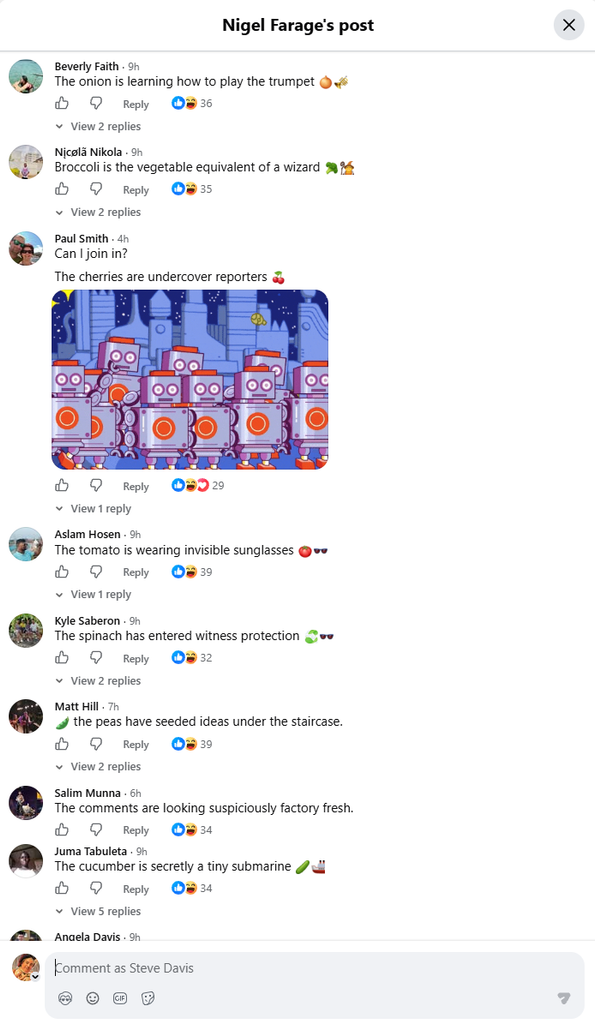
Steve recognises it from a complex website job this week. A Claude trained in the client’s voice produced draft content that sounded right. Someone still has to say yay or nay, and that proofreading was mentally draining. Then comes the cautionary tale. A viral Nigel Farage post about Andy Burnham drew comments that looked like bot output gone wrong, including “The onion is learning how to play the trumpet.” Judgement takes time and costs a lot of energy. As David puts it, no judgement means a big mess.
17:00 Problems This segment answers questions we've received from clients or listeners.
When Outlook Goes Down: The Accessibility Angle on the Microsoft Outage
Outlook went down. You’ll find plenty of commentary on the big Microsoft outage that hit Outlook, Teams and OneDrive, so Steve and David skip the technical post-mortem. They look at something many people missed.
David says nobody loves Outlook. For a blind person using accessibility software, though, it has the best accessibility of any powerful email package. During the outage he forwarded email from his iPhone to Gmail, opened it in webmail on his laptop and acted on it there. Every job took an extra five minutes. Gmail is slow and awkward for a blind user, but it got him through.
Steve’s lesson is about monopoly. Imagine a Microsoft phone and no Gmail account, and you’d have been stranded. Talking between different services can be frustrating, because each one wants to lock you into its world. The pain is worth it. David agrees, which is why he stays competent in three different environments. He can’t be without at least two of them.
20:00 Perspicacity This segment is designed to sharpen our thinking by reflecting on a case study from the past.
Red Rooster’s Wing Snack and the Uplift Test
Times have changed. To finish, Steve plays a 1980s Red Rooster ad for a wing snack at $1.99, built on a pun about a surname and a stereotype. David grew up in South Australia, where Red Rooster wasn’t around. In 1984 he was making friends with Vietnamese people who had been in Australia a year or two and were finding their feet in English. Even then, he says, he would have watched the ad and wondered whether we really had to do this.
Would it run today? David thinks an agency would say no, though some audiences would still laugh. Steve points out that humans learn through mimicry and enjoy the novelty of the other. The ad crosses the line because we’re more aware of the collateral damage when you milk a stereotype for a cheap laugh. David’s test is simple. The ad is culturally crass, and it uplifts nobody.
The segment ends where hungry podcasters always end up: a debate about the pecking order of chicken go-tos, a long drive for a whole bird, and the hope of wings that would make the trip a stone’s throw.
Transcript This transcript was generated using Descript.
A Machine-Generated Transcript – Beware Errors
S09E08
Caitlin Davis: [00:00:00] Thinking about Marketing is a podcast for business owners and leaders, produced by Steve Davis and David Oldney of Talked About Marketing. More than 8,000 conversations have taught them something. You can’t read the label from inside the bottle. Everyone needs external perspective. Through their four Ps, person, principles, problems, and perspicacity, yes, you heard that correctly, they explore marketing with curiosity, generosity, and the occasional gentle eye roll.
They hope this becomes a trusted companion on your journey in business[00:01:00]
Steve Davis: David, we’re going on a journey in this particular episode. I’m not exactly sure where we’re going to land yet. Should I let us decide or hand that over to a bot?
David Olney: I think we’ll send the bot first and get it to come back and report on what it finds
Caitlin Davis: Our four Ps. Number one, person. These are insights for the whole person, not just the business operator. Oscar Wilde put it this way, ‘The aim of life is self-development, to realize one’s nature perfectly. That’s what each of us is here for.’
Steve Davis: In the person segment, I thought we’d talk about this book before we forget about it.
And it’s got, what’s it called? Before We Forget How to Connect. David, you love this book. I
David Olney: love this book.
Steve Davis: [00:02:00] What brought it onto your radar?
David Olney: Listening to Vin Jang’s YouTube channel occasionally and thought this guy really is very, very good at communications, but he’s also very, very shiny. You know, like you can tell he’s been on the, the top tier US keynote speaker circuit for a few years, and is just an amazing communicator.
And what I liked when he started talking about the book coming out is he started talking more about why he had to become a good communicator. And I found once I heard that version of him, rather than the super shiny, perfect keynote performer, I thought, this guy’s gone from barely being able to communicate to being a master communicator and knows you can get there one step at a time.
Vinh Giang: Before I was born, my teenage father stood on a beach in Vietnam, looked at his family and said, “If my body washes ashore, you’ll know.” My family were trying to escape Vietnam. They were regular [00:03:00] people trapped within a communist regime. Their businesses had been taken first, then their money, then any reason to stay.
Leaving for a safe country became their only goal. Unfortunately, the Viet Cong patrolled local waters with a vengeance. Desperate villagers bought and boarded poorly constructed boats in the dead of the night. Sometimes their bodies washed ashore later, a morbid example of the impossible risks people were willing to take for safety and freedom.
To learn the Viet Cong patrol routes, my dad and his brothers became fishermen. While they cast nets, they also cast their eyes on patterns: where the Viet Cong went, how often, and when the coast was clear. They discovered something, an opportunity. On the stormiest and most dangerous nights, there were no patrols, so Dad made a plan.
He would go first. “If I make it to the refugee camp in Malaysia, I’ll send word back. If my body washes ashore, [00:04:00] you’ll know.” Dad boarded one of those boats and headed into the storm, but he didn’t get far. Within a kilometer of the shore, the waves smashed the boat apart and he had to swim back to land.
That night, soaking wet and exhausted, he gathered the family together. “We can’t trust these people with our lives. We’ll build our own boat.” He was still a teenager.
David Olney: And the book is all about the methodology for becoming a much better communicator one step at a time. Uh, and what I observed from all y- my years of teaching and then doing my master’s in strategic comms is that’s what people who are struggling with communication actually need, a one step at a time way to get better that allows them to take a little scary step, but get back into safety really quick and feel better because of the gain, and then take another little scary step, and then get back [00:05:00] into a safe place with communications, use it, and then repeat the process.
Steve Davis: And this is in the person segment because at its heart, whether we’re talking in business or just the daily part of life, it’s so fundamental, isn’t it?
David Olney: It is, absolutely, and I like the, the person– I like how personal the book is. Like Vinh’s own story is a story of his family arriving, you know, having escaped Vietnam, been in a refugee camp in Malaysia for two years.
You know, he’s that five-year-old Vietnamese Australian kid who goes to school with no English, and his favorite meal is combination rice with fish sauce. So basically, to every Anglo kid around him, his lunch bo-box would have smelt like something died in it. He’s the kid who wanted to become a magician and got very good at the tricks, but didn’t realize what makes a great magician is a great magician connects with their audience.
And what really makes the book powerful, and [00:06:00] sorry for the spoiler everyone, you should read or listen to it anyway. I think listen because Vin’s sort of voices for different characters are fantastic. Um, is that, you know, Vin and his wife, their first child, Xander, at two was diagnosed with autism, and there was a great fear that he was going to be non-verbal.
And Vin took the approach of, “Whoa, whoa, whoa, whoa, whoa. I’m a terrible communicator when I was a child. I was a terrible communicator at 18. I’ve learnt everything I’ve learnt one step at a time, the hard way. So if I was able to learn all that, and I structure Xander’s learning, so we’re always inside his safe toddler world, and we’re only getting him to do a tiny thing at a time with support, then surely it will help.”
And the book ends with Vin and his wife, uh, Peiwend, sitting– And [00:07:00] I hope I’ve got her name right, Peiwend. Uh, sitting at a school assembly as Xander gets a prize for communications at school.
Steve Davis: Hmm.
David Olney: And the critical thing with the book is it’s all designed so you can learn to be a better communicator by only having to take tiny steps out of your psychologically safe place towards the risk of doing better and making a bigger, nicer world for yourself.
Steve Davis: So-
David Olney: And that’s such a beautiful way to put a book together.
Steve Davis: Uh, I, I agree. And so what is a symptom that we might be experiencing that to you would suggest this book is worthwhile?
David Olney: Relate it to small business immediately Uh, how many small business people know their products so well that when they talk to a customer, they jump to a conclusion about what the customer needs and wants, don’t listen to the rest of the customer’s sentence, [00:08:00] jump straight into the product that solves the perceived problem, and in that very moment, they’ve lost that person and that deal?
How often do small business people jump into their favorite story about the product or growing the business, not realizing that to the customer who has their own problem, their own life, and their own reason for talking to that business person today, the story makes no sense, and a story that makes no sense actually makes someone go, “Why am I bothering to listen to this person?”
Steve Davis: This takes me back. We talked about something similar to this. What was the book called? The Four Questions or The Next
David Olney: Questions? Yes. Yeah. Yeah. The– Well, there was one called The Four Questions. Well, sorry. I think it was called The Next Question, but it was all about the four questions you should ask first or something.
We’ve had a few that are related, and what makes this a much better book than any of them is that it works from that micro level of assess where you are honestly without shame or, you know, getting too emotionally invested and go, [00:09:00] “How do I make it a little bit better?” Well, here’s how to make it a little bit better.
Lock that in. Now, how do I make my storytelling a little bit better? How do I make my listening a bit better? How do I improve the tone of my voice so I don’t sound like a monotone AI? The great thing here is everything is gentle and incremental, and I’ve not ever encountered a book like this before that does it in such a caring way rather than a, “If you follow my instructions, you’ll be fabulous way,” which doesn’t really work.
Steve Davis: Well, we’ll put a link to it in the show notes. Sam, thank you for opening the door for us.
David Olney: Thank you for listening to me gush about it.
Caitlin Davis: Our four Ps. Number two, principles. These are ideas worth building on. As Oscar Wilde reminded us, you can never [00:10:00] be overdressed or overeducated.
Steve Davis: In the principles segment, talking of gushing, you were gushing to me recently, David, about a master prompt that you’ve written that you’re, you’re quite proud of, and maybe we might look at that a little c– more closely and reflect on some of the, uh, unintended consequences as a great principle for the way we adopt and embrace AI in our daily work.
David Olney: Absolutely, and the unintended consequences is going to be the majority of what I’m gonna say, ’cause I will gush about my Godzilla prompt. I call it the Godzilla prompt because it’s awesome and it’s kinda scary how well it works.
Steve Davis: What does it
David Olney: do? So for context, in my American job with Speakeasy Marketing, we realized that we need to basically search the internet every week, which I do with an AI scraping the internet, looking for relevant news items for attorneys that will help them [00:11:00] that relate to the products we provide.
So of course, we’re getting something out of it. We’re going, “Look, here’s a relevant news thing. You need to be thinking about this thing about AI or this thing about billing or this thing about marketing. By the way, we can help you with that.” And it quite simply is very slow to do with people because people can only work so fast, and you don’t wanna burn people out doing what is essentially ephemeral content, and news content doesn’t last long.
So I built my Godzilla scraper that can go twice a week and find the five most relevant items for small law firms in America twice a week. That’s amazing. Too much for the marketing and writing team to turn into content. So I thought, “Right, now I’m gonna build the Godzilla content prompt,” which takes those five items twice a week and in eight minutes turns them into three blogs, three emails, three LinkedIn posts, and three Facebook posts for every news item I feed into it.[00:12:00]
One in the style of Robert Collier, one in the style of Ray Edwards, and one in the style of Drew Eric Whitman. Is it great copywriting? No. Is it excellent copywriting? No. It’s good copywriting that needs polishing by a person. And the unexpected consequence of being able to generate so much good but not great content is when I hand over these automated packs of content every week to the marketing and writing team I’m exhausting them without meaning to.
I’m giving them so much work to polish so we can flood the zone with good news material for small law firms that they don’t then have time to work on evergreen content. They don’t have time to work on things critical for our website. They don’t have time to work on things that require a lot of thinking.
So my big takeaway from this is AI at the moment is at its best when it’s [00:13:00] automating something that people can do, where a person gets it started, a person adds the polish. So human, AI, human. But the unexpected consequence of suddenly I’ve overwhelmed two teams with the amount of work I can throw their way that it’s made their week unbalanced, and now I have to work out how to give them balance back so that in a sense, something that might be a bit useful doesn’t actually become destructive.
Steve Davis: It’s an interesting insight because I even experienced it this week. We’re working on a very complex website, and we had to rely on a trained Claude, trained in the client’s voice, to pass a whole lot of information and I won’t, I won’t even try to attempt why it was so complex. But when, um, it generated the draft content, which was all in our voice and sounding good, it was a big job.
It was mentally draining to go through because you’re a proofreader now, and you’ve got these, [00:14:00] uh, this is the moment. This is the moment when you say yay or nay to what’s been, uh, crafted. So there’s no get out of jail free card. It’s all easy if you care about the output.
David Olney: Mm. Judgment takes time and costs a lot of energy is really the key takeaway I’ve discovered this week.
Steve Davis: And talking of judgment, because of this big workload, I think it’s fair to say that there are politicians around the world and parties who use armies of robots or bots to, um, make comments on their behalf to fuel anger online. Would you agree?
David Olney: Absolutely, and they don’t show anywhere near as much judgment as you and I at work.
Steve Davis: One politician, uh, I’m gonna use as an example, this might surprise you, uh, Nigel Farage. Have you heard of him?
David Olney: I’ve heard of him, and I’m kind of amazed that he can type on a keyboard.
Steve Davis: Well, he put a piece out, I think it was last week at the time of recording, uh, going on against, uh, Andy Burnham, blah, blah, blah, [00:15:00] and this post went viral for the wrong reasons.
All the little bot armies that normally chime in and add fuel to the fire and something went wrong. And there were quotes like this from Radin Putra, whoever that is. “The lettuce has become a motivational speaker.” Okay, you see that? That’s a bit weird. Then there’s another one, Fendi- Fendi Bob, “The onion is emotionally attached to a fork.”
Lawrence Mahmoud, “The banana uses a human for scale.” And then Beverly Faith, “The onion is learning how to play the trumpet,” and so on and so forth. Something went wrong in the bot factory. You can see the pattern they’re using for what are normally drive-by inflammatory comments to make people angrier.
Instead, they were nonsense, David.
David Olney: I love a good doses of, of absurdism, [00:16:00] particularly when related to absurd people.
Steve Davis: And then people joined in. A guy called Paul Smith said, “Can I join in?” And then he did a, a quick image, and it said, “The cherries are undercover reporters.” And they picked up on this and applied ridicule to it.
So I think both of these, uh, stories work together. You using your Godzilla prompt, understanding there is still a demand and a tax on human attention to make it worthwhile, and the price when you turn a blind eye and let it go fully automated.
David Olney: Yeah. No judgment, big mess
Caitlin Davis: Our four Ps. Number three, problems. These are the marketing challenges keeping you up at night. As Oscar said, we ask questions for the best reason possible. Simple [00:17:00] curiosity, no hidden agenda, just genuine interest in what’s actually happening.
Steve Davis: Something different in the problem segment. I’m sure there’s lots of commentary online by the time this goes out about the big Microsoft outage that impacted Outlook, Teams, OneDrive, et cetera.
And we’re not gonna bore you by going through that again. But David, when you were talking to me about it, you picked up an accessibility aspect to this that might have gone unnoticed by many.
David Olney: Yeah. This is one of these strange moments where I rely on techno- you know, technology very heavily to do everything, so I’m always fairly vulnerable.
But something like Outlook, like no one likes Outlook. We can safely say there isn’t an Outlook user in the world who likes Outlook. But for a blind person using accessibility software, Outlook has the best baked-in accessibility for a powerful email package app. [00:18:00] So the irony is today I’ve been having to, you know, forward things from my iPhone to my Gmail to open it in web mail on my laptop to then be able to action things that I would normally do in Outlook in two seconds.
So I’ve had this merry-go-round today of going, “Well, thank goodness my iPhone is still accessible. Thank goodness I can send things to Gmail and use it as web mail. Wow, how horrendously slow and useless is Gmail to use as a blind person. Phew, but I can get to the email, so I’m back on track.” But every job today has taken about an extra five minutes as I do the juggling act to find a way to access the email that currently won’t work properly in Outlook.
Steve Davis: So for me, my takeaway from this is, gee, we’re lucky we haven’t put all our eggs in one basket. Yes,
David Olney: absolutely.
Steve Davis: [00:19:00] And this is the downside of monopoly. Imagine if your phone was a Microsoft phone and there was no Gmail account.
David Olney: Exactly.
Steve Davis: Uh, you would’ve been totally stranded. And I think that’s the lesson for all of us, is as frustrated as it…
as frustrating as it can be to talk between these different services, ’cause they want to lock you into their world, it’s worth the pain.
David Olney: Yeah. It’s absolutely reinforced why I try and stay competent in three different environments, ’cause I can’t be without at least two of them.
Caitlin Davis: Our four Ps. Number four, perspicacity. Let’s examine a campaign from the past and ask, would it work today? As Oscar Wilde believed, our one duty to history is to rewrite it. So let’s see what we can learn.
Steve Davis: It’s, um, [00:20:00] it’s hungry work doing a podcast, and in case you’re peckish, we’re gonna finish in perspicacity with an ad that Red Rooster ran many years ago.
And guess who it stars, David?
David Olney: I don’t wanna guess, because I remember Red Rooster very much being, uh, an eastern state thing, and I think the only time I went to Red Rooster regularly was in Queensland in the ’80s. So- … I think it’s gonna be pretty weird.
Steve Davis: Well, it was the 1980s. You could be forgiven for calling them redneck when you hear this ad.
It was featuring Mr. Wing and Mr. Wong.
David Olney: Oh, dear.
TV Ad: Meet two of the world’s greatest lovers of chicken wings, Mr. Wing and Mr. Wong. Mr. Wong buys whole chickens just to get the wings, which is wong. Thank goodness Red Rooster now offer a delicious new Oriental Wing Snack. Three succulent wing pieces, sweet and sour sauce, golden chips, all for just $1.99.
Vinh Giang: Ah, [00:21:00] Red Rooster.
TV Ad: Oh, Rocky guy. Red Rooster’s new Oriental Wing Snack. Now, when you want wings, you can’t go wong.
Steve Davis: David, there we go. I’m pretty sure Red Rooster would not run an ad like that these days, would they?
David Olney: I think today that the agency would say no, but I still think there’s a fair chance the audience, there’d still be people who think that’s funny. So it’s kind of ironic that people used to pick on marketing for being childish and out of touch with society, and pushing limits just for the sake of sales, when in reality, I think it would now be the agency who would go, “We really recommend you don’t do that.”
Steve Davis: Now, I mean, we both, we’re both children now of the 2020s, so we look at it with those eyes. You were particularly sensitive to this in the light of the book you were just reading.
David Olney: Exactly, because it reminded me that in the time of this [00:22:00] ad, I was making friends with Vietnamese people who’d been in, you know, Australia for a year, two years, and were struggling to get their English together.
And because I am so much a, I like listening to voices and I like helping people to, you know, to speak the way they want to, I used to just enjoy helping my Vietnamese friends with their English. So to me, even in 1984 when that ad came out, I don’t remember that ad ’cause I don’t think we had Red Rooster in South Australia.
But even in ’84, because of who I was becoming friends with, I would’ve already seen that ad and gone, “Oh, do we really have to be doing this?” Even then.
Steve Davis: Yeah, ’cause I mean, humans learn through mimicry.
David Olney: Yeah.
Steve Davis: And there is a fascination and a novelty with, in quotes, the other, and there’s fun to trying different accents.
That’s what people like- Yeah … doing, impersonations, et cetera. But I think the reason this ad would not run today is it crosses the line. Or, uh, uh, for the [00:23:00] reasons you said, an agency wouldn’t necessarily wanna be beholden to it, but it’s just, we’re more sensitive to the fact that there could be collateral damage, uh, when you’re just milking a stereotype for a cheap laugh.
David Olney: Yeah, it’s culturally crass. There’s nothing clever. It doesn’t uplift anybody, and I think that’s really the test here. You know, there’s so many ways that, you know, you could do an ad and there’d be some sort of uplift in it, and, and there’s no uplift in that ad of anybody.
Steve Davis: I am hungry, though.
David Olney: Yeah, I’d, I’d rather have the whole chicken than the wing ’cause, you know, there’s not really much meat on a wing.
Steve Davis: Well, that’s right. Shall we go to Red Rooster to perhaps bless them that they’ve come full circle and wouldn’t run it these days? Or what, what’s the pecking order of your chicken go-tos?
David Olney: I think it’s a very good thing you have an EV ’cause I reckon we’re gonna have to drive a long, long way.
Steve Davis: If only we had wings.
David Olney: We could fly like a chicken.
Steve Davis: Is that the equivalent of a stone’s throw? [00:24:00]
David Olney: Yep.
Caitlin Davis: Thanks for listening to Talking About Marketing. If you found this helpful, please share it with someone who might benefit. And if you’re so inclined, leave a rating in your podcast app. Both help more than you think. Steve and David welcome your thoughts, which you can send to podcast@talkedaboutmarketing.com.
That’s podcast@talkedaboutmarketing.com. Want to continue the conversation beyond the podcast? You can book 20 minutes with Steve at talkedaboutmarketing.com. No cost, no obligation. And we’ll leave the last word to Oscar Wilde, “There’s only one thing worse than being talked about, and that’s not being talked [00:25:00] about.”